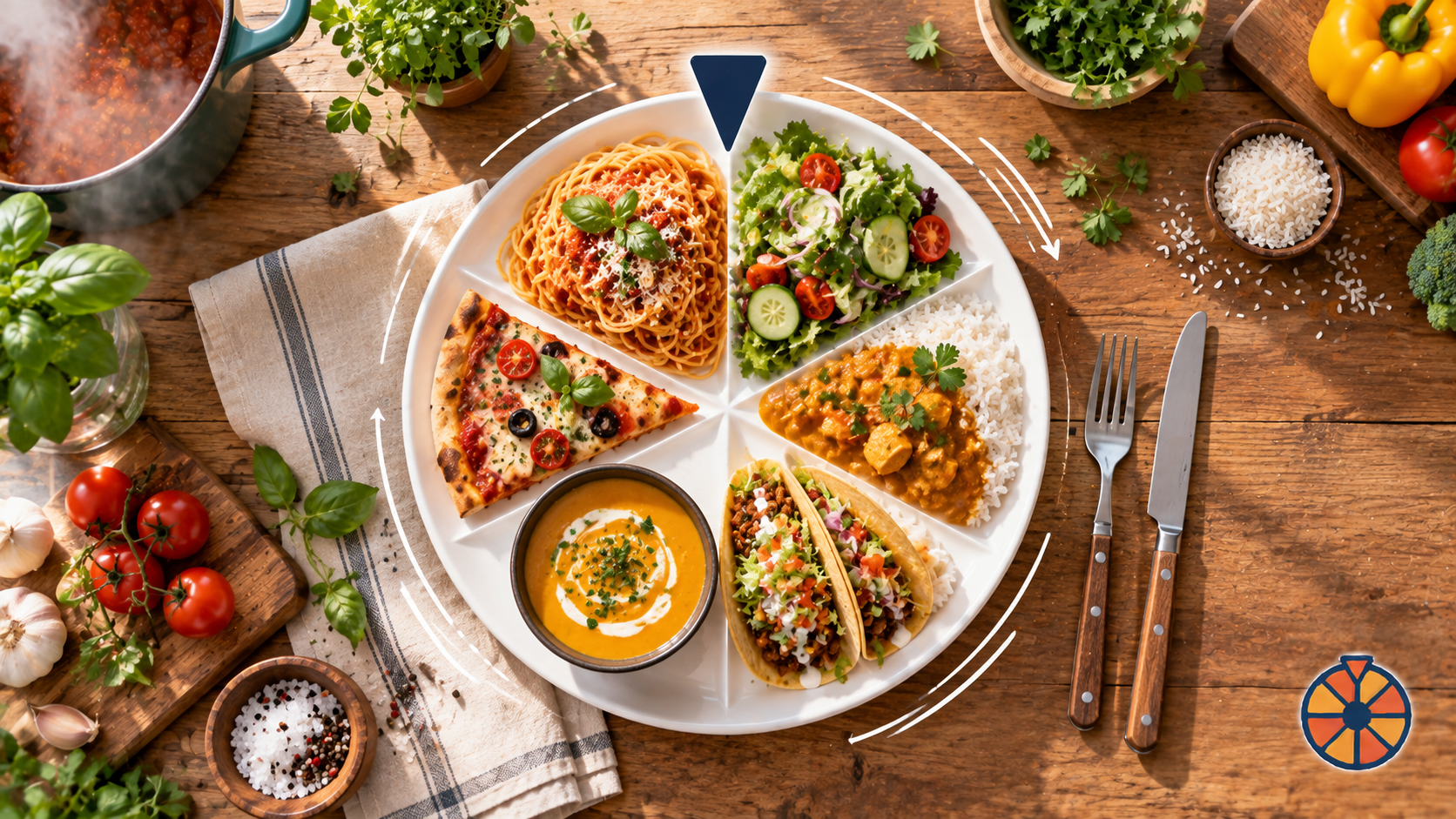
What Should I Eat Tonight? How to End the Daily Dinner Debate (Plus 40 Ideas to Spin)
Stop trying to pick the best meal out of everything on earth. Write down twelve meals you can actually cook, then let something else choose one. The shortlist does the thinking; the pick just ends the conversation.
- The dinner question is hard because the option set has no edges and you answer it at the worst hour of the day, tired and on behalf of other people.
- Constrain first, randomize second. A shortlist of 10 to 20 meals removes the hard part, and picking one from a short list is easy enough to hand to a wheel.
- Twelve meals plus a night out and a leftovers night fills a fortnight with no repeats, and twelve is small enough to write in ten minutes.
- "I don't mind, you choose" is not politeness. It moves the work onto someone else and keeps the veto. Agreeing a list earlier in the week removes that trade.
- Do not randomize around allergies, a real craving, a tight budget or a sick household. Fix the list, then spin the list.
Somewhere between five and seven in the evening, in most households, the same conversation happens. What do you fancy? I don't mind. Shall we just get something? We got something on Tuesday. There is nothing in. There is plenty in, you just don't want any of it. Forty minutes later somebody eats toast standing up.
It is a very small problem that you solve very badly, roughly 365 times a year. Most decisions are big and rare, or small and rare. Dinner is small and relentless, and the standard advice is useless: "meal prep on Sunday" assumes a Sunday you do not have, and "cook what you feel like" assumes you know, which is the thing you do not.
So: why it is genuinely hard, including the research that supports that and the research that does not. Then the fix, which takes twenty minutes once and five seconds a day after. Then 40 dinner ideas to copy straight onto a wheel.
Why is deciding what to eat so hard?
Because the option set has no edges and no natural order. Almost every other daily decision arrives with a menu attached. Dinner arrives as "anything, from anywhere, on a table within the hour, that four people will eat". That is not a choice, it is an open search, run at the end of a working day.
Three things stack up here. Two are described badly almost everywhere; the third is the one that matters.
You make more food decisions than you notice
One number gets quoted in every article on this subject: about 226 food decisions a day. It comes from a 2007 paper by Brian Wansink and Jeffery Sobal in Environment and Behavior. They asked 139 people how many food-related decisions they made in a normal day; the average guess was 14.4. Adding up what those people had actually chosen, across meals, snacks, drinks, portions, second helpings and where to eat, gave an average of 226.7.
Use it carefully. Wansink resigned from Cornell in 2018 after the university found he had committed research misconduct, and 18 of his papers have been retracted; this one has not, but a self-reported total from 139 people was never a precise measurement anyway. Treat 226.7 as an illustration, not a statistic. The direction survives: the 6pm question is not one decision, it is the one you happen to notice, sitting on a stack you have been paying for all day.
Decision fatigue is a weaker idea than it sounds
The explanation offered next is usually decision fatigue: choosing uses a finite resource, so by evening the tank is empty. Do not lean on it. The laboratory effect underneath it, ego depletion, was properly tested in 2016 by Martin Hagger and colleagues: 23 laboratories, 2,141 participants, one protocol registered in advance. The pooled effect was d = 0.04, 95% confidence interval -0.07 to 0.15, an interval containing zero. You do not need the theory anyway. At 6pm you are tired, often hungry, usually beside someone else who is tired and hungry, with under forty minutes. Same pattern at work in decision fatigue and remote teams: the fix is never "try harder at 5pm", it is "make fewer decisions at 5pm".
Choice overload is real, but only under conditions dinner happens to meet
The famous study is Sheena Iyengar and Mark Lepper's, in the Journal of Personality and Social Psychology in 2000. In a grocery store in Menlo Park, California, they ran a jam tasting booth showing either 24 exotic Wilkin & Sons flavors or 6, and gave everyone a $1 coupon so purchases could be traced to the display. The big display pulled the bigger crowd: of 242 shoppers passing the 24-jam table, 60% stopped, against 40% of the 260 passing the 6-jam table. Then it reversed. Nearly 30% of those who stopped at the small display bought a jar. Only 3% at the big display did.
Here is the caveat most articles skip: choice overload does not happen every time. Alexander Chernev, Ulf Böckenholt and Joseph Goodman pooled 99 observations from 53 studies covering 7,202 participants in the Journal of Consumer Psychology in 2015, and averaged across everything the effect of assortment size was not statistically significant. Big menus are often fine. But they identified four conditions that reliably flip it, and dinner meets all four at once:
| Condition (Chernev et al., 2015) | What it means | How dinner scores |
|---|---|---|
| Choice set complexity | Options are hard to line up | Curry, salad and lasagna differ on time, cost, effort, health, washing up and who will eat them. No common scale. |
| Decision task difficulty | Time pressure and distraction | You decide at 6pm, tired, often with a child attached to your leg, before everyone gets unbearable. |
| Preference uncertainty | You do not know what you want | "What do you fancy?" is a question almost nobody answers honestly at the end of a working day. |
| Decision goal | Browsing, not committed to any option | Your goal is not "eat this meal", it is "be fed". Any of thirty answers would do, which is what makes choosing slow. |
That table is the real answer. Dinner is not hard because you are disorganized. It is the textbook case of the one situation in which more options make people worse at choosing, and it repeats every day.
Why is "I don't mind, you choose" the worst possible answer?
Because it is not neutral. It hands the work of deciding to someone else while keeping the right to be disappointed by the result. Two people can play it at once, and then nobody decides anything and both feel put upon. It is the most common failure mode in couples, and it is not about food.
Watch the shape of it. A asks. B says they don't mind. A proposes something. B makes a face, or says "if you want", which is the same face in words. A now has less information and less goodwill. Eventually A stops proposing, because proposing has become a way of being wrong, and then it is 7:40.
The load is unevenly distributed, and there is good sociology on it. In "The Joy of Cooking?", published in Contexts in 2014, Sarah Bowen, Sinikka Elliott and Joslyn Brenton interviewed 150 female caregivers with children aged two to eight and spent 250 hours observing twelve families. Across every income level the mothers described the same thing: time pressure, money trade-offs, and what the authors call the burden of pleasing others. Cooking was rarely the hard part. Finding a meal everyone would eat, night after night, was.
That is a decision problem wearing an apron. The cook is not only choosing food, they are satisfying three or four other people whose preferences change without notice.
So the fix has to do two things. Shrink the option set, and move the agreement earlier, to a moment when nobody is hungry. Both people say yes to the list on Sunday; on Wednesday nobody has to say yes to anything. It is the same point we make about group decisions in why fair decision-making matters: what people object to is usually not the outcome, it is being handed an outcome they had no part in shaping.
What is the five-minute fix for the dinner question?
Constrain the option set first, then randomize inside it. Write a shortlist of 10 to 20 meals you can genuinely cook, keep it somewhere you can reach in three seconds, and let a wheel pick tonight's. All the judgment goes into the list; none goes into the evening.
The order matters more than anything else here, and it is where "just use a random meal generator" fails. A generator seeded with the entire internet hands you something you cannot cook, have no ingredients for, and would not have chosen. You reject it, spin again, reject again, and you have added a slot machine to your evening instead of removing a decision. Randomizing an unconstrained set is not a decision aid, it is noise.
Randomizing a set you already approved is a different thing. Every outcome is acceptable before you see it, so the result cannot be wrong. That is why a coin toss settles an argument even though the coin knows nothing about it: both people agreed to the outcomes in advance. We took that apart in is a coin flip really 50/50, and it applies to a twelve-slice wheel exactly as it does to two faces.
There is a second benefit. When the wheel lands on chili and you feel a flicker of disappointment, you have learned what thinking could not tell you: you wanted the other thing. Take it. The pick is not a verdict, it is a probe.
How do you build a dinner shortlist that actually works?
Twelve meals is the target. Write only meals you have cooked before without a recipe open. Exclude anything needing a special trip, anything only one person will eat, and anything you have never made. Add two non-cooking nights and you have covered a fortnight without a single repeat.
The arithmetic is why twelve works. A fortnight is 14 evenings, and almost every household eats out or eats leftovers at least twice in two weeks. That leaves 12 cooked dinners, so a 12-meal shortlist covers two weeks with nothing appearing twice, comfortably below the point at which people start saying "we always have the same thing".
Not what you would like to cook. What you did cook. Check your bank statement if you cannot remember. Most people already have six to nine meals in rotation and never wrote them down. That is half the list, with no aspiration involved.
See what is missing: something under 20 minutes, something for a bad day, something with no washing up, something from cupboard items when the fridge is empty. One meal per gap. Categories are far easier to answer than "what else do you like".
Would you make this at 6:40pm on a Wednesday, from what is in the house, without opening a recipe? If not, it is a Saturday project, and Saturday projects belong on a different list that nobody spins.
Read the list out. Anyone in the household strikes one or two items, no justification required. This is the step that stops the mealtime argument, because it moves every objection to a moment when nobody is hungry.
On the fridge, or in a picker you can open on your phone in the kitchen. A shortlist in a drawer is not a shortlist. Review it once a season and leave it alone otherwise.
What to leave off
Four kinds of meal quietly wreck a rotation. Anything needing an ingredient you buy specially, because the night it lands you will not have it. Anything only one person eats, because it guarantees a second meal. Anything you have never cooked, because a shortlist is not a place to learn. And anything over 90 minutes on a weeknight.
Two things people leave out and should not: one meal built entirely from the cupboard and freezer, for the week the shop does not happen, and one under 15 minutes for the nights that go wrong. Every rotation needs an escape hatch, or it becomes a delivery app.
| Night | Slot | Why it is there |
|---|---|---|
| Mon | Quick weeknight meal | Not the night for ambition |
| Tue | One-pan or one-pot | Low washing up |
| Wed | Anything from the shortlist | Midweek is the hardest to choose |
| Thu | Cupboard and freezer meal | Shop has run down |
| Fri | Out or takeaway | You were going to anyway |
| Sat | Comfort or a longer cook | The only night with time in it |
| Sun | Leftovers or a roast | Clears the fridge |
The slot pattern is optional, but it halves the option set again before the spin: on a Tuesday you spin only the one-pan group.
What are 40 dinner ideas worth putting on a wheel?
Here are 40, grouped by the kind of evening you are having rather than by ingredient. Take one group, or eight favorites from across all five, and paste them into a wheel. They are written as meals, not recipes, so each is something you can picture cooking rather than a link you have to open.
Copy the group that matches tonight: quick weeknight when you have half an hour, comfort when the day was bad, one-pan when the sink is full, no-cook when it is too hot or too late, around the world when the rotation has gone stale.
How they are written matters more than the list itself. Each names a finished plate, not an ingredient. "Chicken" is not a dinner idea, it is a question with three more inside it. "Chicken and chorizo rice" is one, because when it comes up you know what happens next. Half the difficulty of "what should I eat" is people holding ingredients in their heads and solving for a meal in real time.
Eight to twelve of these on a wheel is plenty. Forty reintroduces the exact problem you were removing.
How do you decide where to eat out or order from?
The same way, one level up: narrow by cuisine first, then randomize inside the cuisine. Choosing between "Thai, Italian or burgers" is a decision a tired person makes in four seconds. Choosing between 180 restaurants on a delivery app is the jam display again, with the added problem that the app is optimizing for something other than your evening.
Delivery apps are choice overload built on purpose: endless scroll, no natural stopping point, every listing designed to look equally plausible, and a sort order you did not choose. Two-stage narrowing kills it:
Five or six cuisines you actually order, on a wheel. Spin. Now you have "Vietnamese" instead of "food", and you have removed most of the app in one move. A world cuisine picker does this, or type your own six.
Nobody has 40 good local restaurants. You have three or four per cuisine that you go back to. Those go on the second wheel.
Budget, delivery radius and how long you will wait are constraints, not tie-breakers. Apply them while writing the list.
For the version of this argument that happens in a car park with four people who all said they didn't mind, /restaurant-picker-wheel exists so nobody has to be the one who chose. When the honest answer is fast food and the only question is which, /fast-food-picker settles it faster than the conversation would.
Can you spin a whole meal at once?
Yes, and it is more useful than it sounds. A combination picker draws a starter, a main and a dessert in one go, so instead of three separate decisions you get one outcome with three parts. For dinner parties and anything where the meal is the event rather than the fuel, use this version.
It works because the parts of a meal are not independent decisions, though you treat them as if they are. You choose the main, re-open the question for the side, then again for pudding, and each re-opening pays the full cost of the first. A combined draw closes all three at once, which is what /meal-combo-picker is for.
It generalizes past dinner: build a wheel where each slice is a whole evening rather than a dish, such as "Thai takeaway and a film" or "shepherd's pie in front of the football". People accept a bundled outcome more readily, because a bundle sounds like a plan and a single dish sounds like an instruction.
The same logic applies elsewhere with different lists. /breakfast-picker for the morning, a smaller problem because breakfast is already constrained by what is in the house. /healthy-food-picker when the constraint is nutritional, the point being that it lives in the list rather than in your willpower. For the general "just decide" case there is /decision-wheel and /yes-no-wheel, compared in using spin wheels to make decisions faster.
When should you not randomize dinner?
Whenever a wrong outcome would cost something real. Randomizing is only safe when every option on the list is genuinely acceptable, so the answer is usually "fix the list first" rather than "do not spin". If you cannot make the list safe, do not spin.
One more failure mode: spinning until you like the answer. Re-spin four times and you are not randomizing, you are choosing slowly with extra steps, having quietly admitted that some entries are unacceptable. Take them off. If you want to know how a wheel picks, or how weighting and rigging really work, that is are online spin wheels rigged.
How do you turn this into a household habit?
Attach it to something that already happens. The shopping list is the natural anchor: the shortlist generates the list and the list restocks the shortlist, so nobody has to remember a new ritual. Ten minutes on a Sunday buys seven evenings.
Once a week, pick which seven of the twelve are on and write the shopping list from those seven. It takes half the time of writing one from nothing, because you are reading rather than inventing. Then during the week you decide nothing: you spin among the seven you shopped for, and every result is cookable. A shortlist not connected to the shopping is a wish list.
Getting children involved, carefully
Children are very good at this, with one rule: they operate the spinner, they do not write the list. The list belongs to whoever cooks and whoever pays. Once every entry is something you were happy to cook anyway, the outcome arrives with an authority no parent can supply. "The wheel said Wednesday is dal" survives contact with a seven-year-old considerably better than "we are having dal".
Two refinements help. Give each child one veto a week, used before the spin rather than after, which teaches the difference between choosing and complaining. And let each own one slice: a meal in the rotation because they picked it. Ownership does the work persuasion fails at, which is the point of why spin wheels are better than manual decision-making.
The list is the work, the spin is just the full stop
The difficulty in "what should I eat tonight" is not the picking, it is the size and shape of what you are picking from. Dinner hits all four conditions under which more options make people worse off, and it hits them every evening, at the hour you are least equipped for it. Nothing you do at 6pm fixes that. Something you do on Sunday does.
So write twelve meals down. Cross out the ones your household would refuse. Add one you can cook from cupboards and one you can cook in fifteen minutes. Put it on the fridge or in a picker on your phone. Then, on the evenings when you genuinely do not mind, let the list answer. You are not outsourcing your taste; you applied it when you wrote the list.
The wheel is not the clever part. The shortlist is. The wheel just means nobody has to be the person who chose.
Related reading on Wheel Spin Pro
- Using Spin Wheels to Make Decisions Faster — when a random pick genuinely beats more thinking, and when it does not.
- Decision Fatigue and Remote Teams — the same "make fewer decisions late in the day" problem, in a work setting.
- Why Fair Decision-Making Matters — why people accept an outcome they agreed to in advance.
- Is a Coin Flip Really 50/50? — the two-option version of the same trick, and the physics of why it works.
- Why Spin Wheels Are Better Than Manual Decision-Making — removing the human hand, and the argument, from the choice.
- Are Online Spin Wheels Rigged? — how weighted slices really work, and how to check a wheel you did not build.
Frequently Asked Questions
Sources
- Iyengar, S. S., & Lepper, M. R. (2000). When Choice is Demotivating: Can One Desire Too Much of a Good Thing? Journal of Personality and Social Psychology, 79(6), 995–1006. DOI 10.1037/0022-3514.79.6.995.
- Chernev, A., Böckenholt, U., & Goodman, J. (2015). Choice overload: A conceptual review and meta-analysis. Journal of Consumer Psychology, 25(2), 333–358. DOI 10.1016/j.jcps.2014.08.002.
- Wansink, B., & Sobal, J. (2007). Mindless Eating: The 200 Daily Food Decisions We Overlook. Environment and Behavior, 39(1), 106–123. DOI 10.1177/0013916506295573. See the next source on the author's later record.
- Servick, K. (2018). Cornell nutrition scientist resigns after retractions and research misconduct finding. Science / AAAS.
- Hagger, M. S., et al. (2016). A Multilab Preregistered Replication of the Ego-Depletion Effect. Perspectives on Psychological Science, 11(4), 546–573. Pooled effect d = 0.04, 95% CI [-0.07, 0.15] across 23 laboratories and 2,141 participants.
- Bowen, S., Elliott, S., & Brenton, J. (2014). The Joy of Cooking? Contexts, 13(3), 20–25. DOI 10.1177/1536504214545755.
- North Carolina State University (2014). 'Family Meal' Ideal Is Stressful, Impossible for Many Families. NC State News (method summary: 150 caregivers interviewed, 250 hours of observation with 12 families).

Written by the maker of Wheel Spin Pro
The developer behind Wheel Spin Pro's spin engines and 140+ unique pickers, writing practical guides on fair random selection for classrooms, giveaways, and events. More about the project.