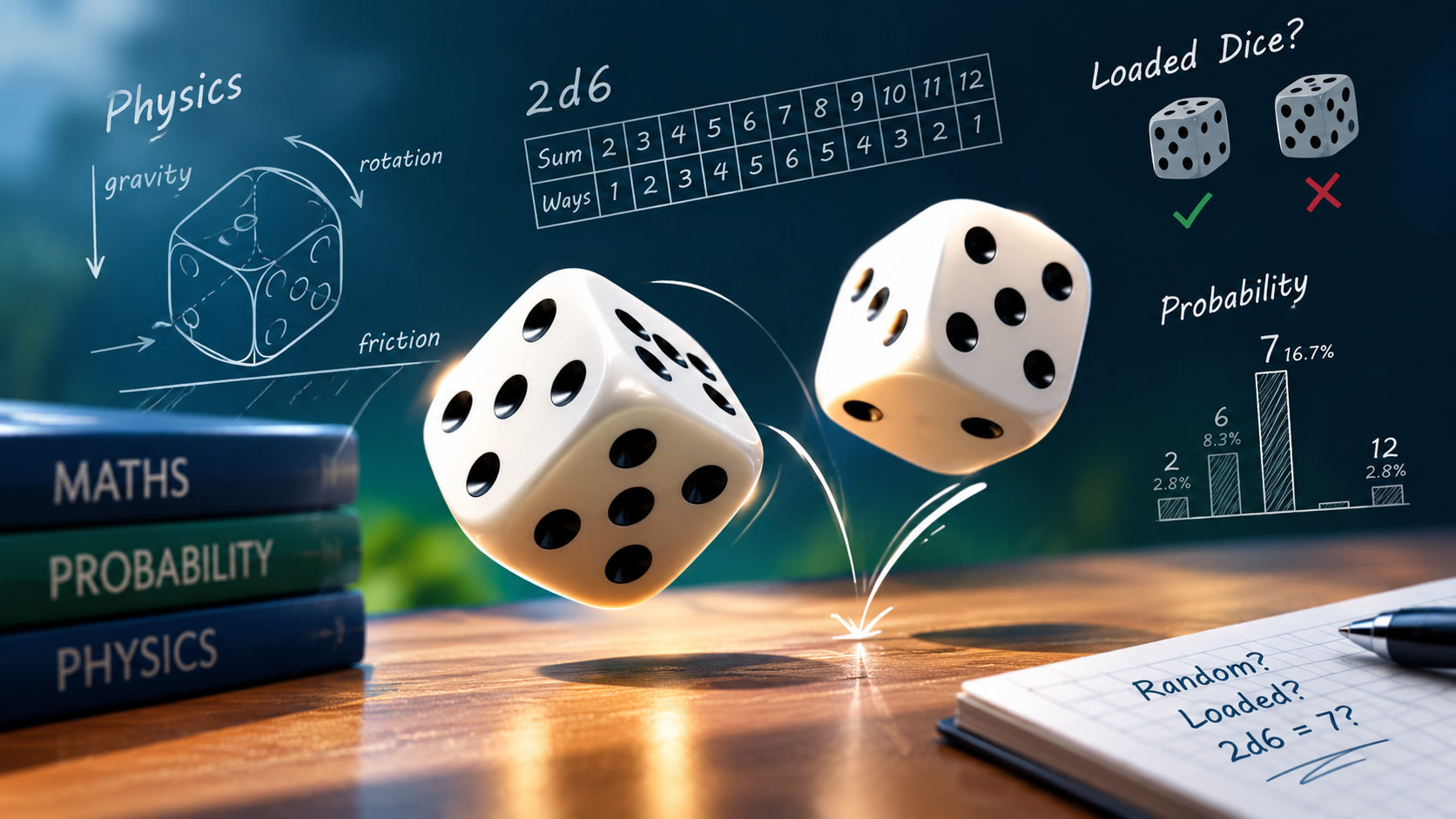
How Random Is a Dice Roll? Physics, Loaded Dice and the Maths of 2d6
A dice roll is deterministic physics that is far too sensitive to predict, so for every practical purpose it is random. The exceptions are a badly made die, a throw that barely bounces, and a player who has the maths of two dice wrong.
- Physicists who filmed dice at 1,500 frames per second found the throw is chaotic in practice: the face that starts lowest is favored a little, but nobody can exploit it without a magician's control.
- More bounces mean less memory of the start. That is why a craps table has a bumpy back wall, and why felt beats a glass tabletop.
- Casino dice are cut to 3/4 inch ± 1/5000 of an inch, are transparent so a hidden weight would show, and carry serial numbers.
- On two six-sided dice, 7 comes up 6 times in 36 (16.7%). A 2 or a 12 comes up once in 36 (2.8%).
- Advantage on a d20 turns a 50% chance into 75%, and a natural 20 from 5% into 9.75%. The arithmetic is below.
- A digital die draws its face from a cryptographic source first and animates toward it second. If a roll must be provable, the receipt is the difference.
Every board gamer has a story about a die that "hates" them. Every dungeon master has watched a player blow on a d20 before a saving throw. Every teacher who has run a probability lesson has heard a child insist that 6 is the hardest number to roll. This article is the plain-English answer to the question behind all of those.
It covers what physicists found when they filmed dice in slow motion, why casinos are so fussy about the back wall, how to test a die you suspect is loaded (maths shown, not waved at), the full 36-outcome table for two dice, what "advantage" does to a d20, and how a 3D digital die on a page like /dice-roll decides which face to show before it starts spinning. If you read our coin-flip article, you will recognise the shape of the argument: a coin has two outcomes and a slight same-side bias, while a die has six outcomes, more bounces, and a much better excuse to forget how it started.
How random is a dice roll, in one sentence?
A fair die on a bouncy surface is random for every purpose that matters, because the outcome depends on the starting position and speed so sensitively that no human can steer it. That is the conclusion of the physics, with three caveats.
First, the die has to be a true cube with its center of mass in the center. Second, the throw has to bounce: a die that slides to a stop after one tumble carries a memory of how it left your hand; one that clatters six times does not. Third, "random" describes the single roll, not the pattern. Two dice are not flat: a 7 is six times as likely as a 12, and a surprising number of arguments at game tables come from forgetting that. None of this requires a computer. Where a digital die earns its place is when the roll has to be witnessed by people who are not in the room, or proven afterwards.
What did physicists find when they filmed a die at 1,500 frames per second?
A 2012 study in the journal Chaos built a full three-dimensional model of a die throw, checked it against high-speed video, and found that the face lowest at the moment of release lands up slightly more often than any other, but that the sensitivity to starting conditions is so extreme that the throw "approximates a random process" in practice.
The paper is "The three-dimensional dynamics of the die throw" by Marcin Kapitaniak, Jaroslaw Strzalko, Juliusz Grabski and Tomasz Kapitaniak, of the Technical University of Lodz and the University of Aberdeen. The team wrote equations for a cube falling under gravity, hitting a table, losing energy on each bounce and tumbling under friction, then filmed real dice at 1,500 frames per second to check the model against reality. Their abstract puts the key result plainly: the probability of the die landing on the face that was lowest at the beginning is larger than the probability of landing on any other face.
That sounds like a loophole. It is not, for two reasons. The first is sensitivity: to turn the bias into a prediction you would need the die's position, orientation and velocity at release far more precisely than any hand can repeat. The AIP press release summarised it as: only a good magician can throw a die so as to obtain the desired result. The second reason is the table.
Why the surface matters more than the die
In the model, each bounce is a "discontinuity": the die hits, loses energy, changes direction, and the small uncertainties in its motion get multiplied. The more bounces, the less the final face has to do with the starting face. The authors say this non-smoothness is precisely what makes a mechanical randomizer behave randomly despite being deterministic.
Friction controls the number of bounces. In the Inside Science coverage, Kapitaniak says that on a high-friction table the die bounces more times, tumbling and twirling, which makes the result harder to predict, while on a low-friction surface it bounces less and keeps more of its starting bias. Air resistance can be neglected. A throw would be chaotic in the strict mathematical sense only if the die bounced an infinite number of times, which friction never allows; in practice it bounces a handful of times, and a handful is enough.
The practical reading for a games night: roll on cloth, not a glossy coffee table, and roll so the die actually tumbles. Casinos worked this out long before the paper did.
Why do casinos use precision dice and make you hit the back wall?
Because the two things that make a die predictable are an imperfect cube and a throw that does not bounce, and a craps table removes both: the dice are machined to a fraction of a thousandth of an inch, and the shooter must throw them against a wall of rubber pyramids or the roll does not count.
Start with the dice. According to the Wikipedia entry on dice, precision casino dice are cut from bars of extruded cellulose acetate so each face is as square as practical, with edges of 3/4 inch plus or minus 1/5000 of an inch. The pips are drilled and filled with paint or epoxy that matches the density of the material removed, so a face with six holes weighs the same as a face with one. The dice are transparent, which makes it difficult to hide an internal weight, and each carries a serial number and the casino's logo so a shooter cannot swap in a doctored pair. A hobbyist explainer on precision dice describes the tolerance being checked with a micrometer, and notes that the sharp "razor" edges act as a brake so the dice stop tumbling soon after they hit the wall.
Now the throw. The dice-handling rules described by Craps Desk are consistent across casinos: one hand, both dice must hit the back wall on every throw, they must stay over the table, the shooter may not switch dice, and if a die leaves the table the boxman inspects it before it returns to play. The Wizard of Odds craps page says it in fewer words: when you throw the dice they are supposed to rebound off the other side of the table.
Put that list next to the physics and the logic is obvious. The back wall is lined with rubber pyramids so the dice bounce unpredictably rather than sliding. One hand and no switching guard against a swapped die. The whole ritual forces the "many bounces" side of the diagram above, every time, with a die that has no built-in preference.
How can you tell if a die is loaded?
Two tests, one quick and one real. Float the die in salt water and see whether the same face keeps surfacing; then, if it fails, roll it 60 or more times and run a chi-square test on the counts, because the float test alone is not proof.
The salt-water float test
The method, as described on the RPG Museum wiki, is simple. Stir table salt into warm water until no more dissolves, drop in the die (acrylic and resin float; metal, stone and glass sink whatever you do), flick it to spin, and note which face is on top when it settles. Repeat ten or twenty times. If different faces come up, the weight is spread evenly. If the same face keeps surfacing, the die is heavier on the opposite side.
That will catch a hollow bubble or badly mixed resin. What it will not tell you is whether the imbalance is large enough to matter on a table. The RPG Museum entry itself notes that dice bias is more likely to come from imperfections in shape than from internal weight, and shape is invisible to a float test. Gnome Stew, a long-running tabletop blog, put the test on trial: only 4 of 22 dice would float at all, and one d20 that consistently surfaced 20-up was then rolled 100 times and produced 4 twenties against an expected 5, a p-value of about 0.35. Their verdict was that the float test is impractical and not supportable on its own. The way to know what a die does on a table is to roll it on a table.
The roll-count chi-square test, with a worked 60-roll example
Roll the die 60 times on the surface you play on and tally each face. Sixty is convenient because the expected count for a fair d6 is exactly 10 per face, above the usual minimum of 5 for the test to be reliable. Suppose your tallies come out like this:
| Face | Observed (O) | Expected (E) | O − E | (O − E)² | (O − E)² ÷ E |
|---|---|---|---|---|---|
| 1 | 7 | 10 | −3 | 9 | 0.9 |
| 2 | 9 | 10 | −1 | 1 | 0.1 |
| 3 | 8 | 10 | −2 | 4 | 0.4 |
| 4 | 11 | 10 | +1 | 1 | 0.1 |
| 5 | 10 | 10 | 0 | 0 | 0.0 |
| 6 | 15 | 10 | +5 | 25 | 2.5 |
| Total | 60 | 60 | χ² = 4.0 |
The statistic is the sum of the last column: 0.9 + 0.1 + 0.4 + 0.1 + 0 + 2.5 = 4.0. A d6 has six faces, so the test has 6 − 1 = 5 degrees of freedom, and the NIST Engineering Statistics Handbook table gives the critical value as 11.070 at the 5% level and 15.086 at the 1% level. Our 4.0 is well under 11.07, so this die passes. Fifteen sixes in sixty feels like a lot at the table. It is not, on its own, evidence of anything.
Now imagine the tallies had been 6, 7, 8, 8, 9 and 22. The squared differences over 10 are 1.6, 0.9, 0.4, 0.4, 0.1 and 14.4, total 17.8. That clears both thresholds, so you could say with better than 99% confidence that the die is not fair. Notice how big the sixes column had to be: more than double the expected count. Small biases need hundreds of rolls to show up, which is why a suspicious feeling after one bad evening is not a test.
Use the mat, cloth or tray you play on; the surface decides how many bounces the die gets.
Expected count per face is rolls ÷ 6. Keep it at 10 or above.
One row per face, then add the rows. The table above is the template.
Under the threshold: no evidence of bias. Over it: retire the die.
What are the odds of each total on two dice (2d6)?
There are 36 equally likely ways two dice can land, and 7 is made by 6 of them (16.7%), while 2 and 12 are made by 1 each (2.8%). The totals form a triangle, and every board game from Monopoly to Catan is built on that triangle whether the designer says so or not.
The reasoning is short. Die A can show any of 6 faces, and for each of those die B can show any of 6, so there are 6 × 6 = 36 ordered pairs, each with probability 1/36. A total of 2 needs (1,1): one way. A total of 3 needs (1,2) or (2,1): two ways. The count rises by one for each total up to 7, which can be made six ways, and then falls back down. Maths Is Fun lays out the same 36-cell grid and the same 1, 2, 3, 4, 5, 6, 5, 4, 3, 2, 1 pattern if you want a second pair of eyes on it.
| Total | Ways | Combinations | Probability | Percent |
|---|---|---|---|---|
| 2 | 1 | 1+1 | 1/36 | 2.8% |
| 3 | 2 | 1+2, 2+1 | 2/36 | 5.6% |
| 4 | 3 | 1+3, 2+2, 3+1 | 3/36 | 8.3% |
| 5 | 4 | 1+4, 2+3, 3+2, 4+1 | 4/36 | 11.1% |
| 6 | 5 | 1+5, 2+4, 3+3, 4+2, 5+1 | 5/36 | 13.9% |
| 7 | 6 | 1+6, 2+5, 3+4, 4+3, 5+2, 6+1 | 6/36 | 16.7% |
| 8 | 5 | 2+6, 3+5, 4+4, 5+3, 6+2 | 5/36 | 13.9% |
| 9 | 4 | 3+6, 4+5, 5+4, 6+3 | 4/36 | 11.1% |
| 10 | 3 | 4+6, 5+5, 6+4 | 3/36 | 8.3% |
| 11 | 2 | 5+6, 6+5 | 2/36 | 5.6% |
| 12 | 1 | 6+6 | 1/36 | 2.8% |
A few consequences worth knowing. The middle totals from 5 to 9 cover 24 of the 36 outcomes, two thirds of all rolls. A 7 or 11 together come up 8 times in 36 (22.2%) and a 2, 3 or 12 together 4 times in 36 (11.1%), which is why the come-out roll in craps is shaped the way it is. The chance that at least one die shows a 6 is 11/36 (30.6%), not 2/6, because the (6,6) pair is counted once. In Catan, a settlement on an 8 and a 6 is paid on 10 of 36 rolls; one on a 2 and a 12 on 2 of 36. The pips under the number tokens are exactly the "ways" column above.
2d6 into the Number Dice box at /dice-roll and roll fifty times; the totals pile up in the middle just as the chart predicts. For a plain 1 to 100 draw with no dice at all, /random-number-generator is the flatter tool.
How much does advantage change a d20 roll?
Rolling two d20 and keeping the higher turns a 50% chance (needing 11 or more) into 75%, and a natural 20 from 5% into 9.75%. Disadvantage does the mirror image: 50% becomes 25%, and a natural 20 becomes a 1-in-400 event.
The trick is to think about failing rather than succeeding. With advantage you only fail if both dice fail. If you need an 11 or higher, a single die fails on 1 through 10, which is 10 of 20 faces, or 0.5. Both fail with probability 0.5 × 0.5 = 0.25, so you succeed with probability 1 − 0.25 = 0.75. In general, if the target is k, a single die fails with probability (k − 1)/20, and advantage succeeds with probability 1 − ((k − 1)/20)². Disadvantage flips it: you succeed only if both dice succeed, so the probability is ((21 − k)/20)². A simulation written up on R-bloggers arrives at the same 75% and the same "almost 10%" for a natural 20 by brute force, 10,000 rolls at a time.
| Need to roll | One d20 | Advantage (best of 2) | Disadvantage (worst of 2) |
|---|---|---|---|
| 5 or more | 16/20 = 80% | 1 − (4/20)² = 96% | (16/20)² = 64% |
| 10 or more | 11/20 = 55% | 1 − (9/20)² = 79.75% | (11/20)² = 30.25% |
| 11 or more | 10/20 = 50% | 1 − (10/20)² = 75% | (10/20)² = 25% |
| 15 or more | 6/20 = 30% | 1 − (14/20)² = 51% | (6/20)² = 9% |
| Exactly 20 | 1/20 = 5% | 1 − (19/20)² = 9.75% | (1/20)² = 0.25% |
Two things jump out. First, advantage helps most in the middle: 25 percentage points at a 50% target, 16 at an 80% target, under 5 for a natural 20. Second, the average roll moves a lot. Each value k is the higher of two d20 with probability (2k − 1)/400, and summing k × (2k − 1)/400 for k from 1 to 20 gives 5,530/400 = 13.825, against 10.5 for a single die; the lower of two averages 21 − 13.825 = 7.175. The R-bloggers simulation landed on 13.89 and 7.13, the same answer with sampling noise.
Are "hot dice" real, and what is the gambler's fallacy?
No. A fair die has no memory, so a run of sixes makes the next six neither more likely (the "hot hand" story) nor less likely (the gambler's fallacy). Both beliefs are the same mistake pointed in opposite directions.
The Wikipedia definition of the gambler's fallacy is the belief that an independent and equally probable outcome which has happened less often than expected is more likely to happen in the future, or vice versa. Its most famous illustration is a roulette wheel at the Monte Carlo casino in 1913, where black came up 26 times in a row and players lost a fortune betting on red because a red was "due". The wheel did not know. Each spin was the same fresh chance of black as the one before.
Dice are the same. The chance of three sixes in a row on a fair d6 is 1/6 × 1/6 × 1/6 = 1/216, rare enough that people go looking for an explanation. But the chance of the next roll being a six, after three sixes, is 1/6. The rare event is the run you have already seen, and it is over. Streaks are what randomness looks like; a sequence with no streaks would be the suspicious one. Where a streak should worry you is when it keeps going beyond what the chi-square test allows: three sixes is nothing, twenty-two in sixty is a die to retire. The way to tell them apart is to count, not to feel. Our article on why fair decision-making matters covers the same instinct from the other side: people trust a process far more when they can see it does not remember.
How does a 3D digital die decide its face?
A well-built digital die picks the result first, using the browser's cryptographic random source with rejection sampling so no face is favored, and only then animates the cube toward that face. The tumbling is a picture of the result, not the cause of it.
That order surprises people, so here is why it is right. A physical die produces its outcome from the bounces; the animation and the result are the same event. A digital die cannot do that honestly, because the "bounces" on screen are frames being drawn, and a program that read the result off the animation could be nudged by anything that affects the animation, including how busy the computer is. So the engine on /dice-roll does the opposite. It asks the browser's crypto.getRandomValues for a random 32-bit number, throws it away and asks again if it falls in the small range that would make the modulo step unfair (that is the rejection sampling), and takes the remainder as the face. Then the CSS cube tumbles and settles with that face on top. The same routine backs the Number Dice mode, so a d20 or a 2d6+3 gets the same quality of draw.
Because the result exists before the animation, it can be sealed. Every roll produces a provably-fair receipt that anyone can paste into /verify and have checked without trusting us. If you have ever run a giveaway and been asked "how do I know you didn't just pick your friend", that receipt is the answer, and our guide to fair prize distribution shows how it is used in practice.
When real dice are still better
Often. A physical die at a table with friends is faster, louder, more satisfying and, as the physics showed, random enough. A digital die is the better tool in a narrower set of situations:
The fair objection is that a computer can be programmed to cheat and a die cannot. True, which is why the receipt matters more than the animation. A digital die you cannot verify asks for the same trust as a stranger's die at a craps table; casinos solved that with transparency and serial numbers, and a provably-fair record is the software equivalent.
Can you put your own words on the faces?
Yes. The 3D picker cube on /dice-roll has six faces whose labels you can rewrite (names, chores, verbs, vocabulary, "roll again"), each with its own color and an optional emoji or picture, so the die becomes a six-way picker instead of a number generator.
This is the feature teachers and game masters use most:
- Story dice. A character, a place, a problem, an object, a feeling and a twist. Roll, and the class writes for ten minutes on whatever came up.
- Vocabulary or times-tables practice. Six target words or multipliers on the faces; a projected die is a fairer way to call the next item than pointing at a child. Our classroom guide has more of these.
- Encounter tables and turn order. Six results or six names, one roll, no argument. Use /board-game-picker when nobody can agree what to play, and /random-number-picker or a name wheel when the group is bigger than six.
The receipt still covers a relabelled die: the engine seals the label that was actually shown, so a roll of "Take out the bins" verifies as exactly that. The picker cube stays at six faces; for more outcomes, the notation mode goes up to d100 and a wheel goes to hundreds of entries.
What to take to your next game night
A dice roll is random enough for every game you will ever play, provided the die is a real cube and the throw actually bounces. Physics says the starting face leaks through a little; felt, a dice tray and a proper toss wash it out. If a die feels wrong, count 60 rolls and do the arithmetic. Two dice are not flat: 7 is the king of totals and 12 a rare guest, and half the "luck" in Catan or craps is that triangle. Advantage on a d20 is worth a quarter of your success chance at the mid-range, and nothing you roll tonight is affected by last night. When the roll has to be seen by people who are not at the table, or proven afterwards, use a die that decides first and animates second, and keep the receipt. For the two-outcome version of this story, the coin-flip article is the companion piece.
Related reading on Wheel Spin Pro
- Is a Coin Flip Really 50/50? — the two-outcome version: the same-side bias, the 350,757-flip study, and what a digital coin does differently.
- Why Fair Decision-Making Matters — why a visibly random process gets accepted where a judgement call gets argued with.
- Spin Wheels for Fair Prize Distribution — using a witnessed, receipted draw when there is something worth winning.
- What Is a Spin-the-Wheel Game? — the wheel as the many-faced cousin of the die.
- 50+ Spin Wheel Ideas for the Classroom — where custom-face dice and name wheels fit into a lesson.
Frequently Asked Questions
Sources
- Kapitaniak, M., Strzalko, J., Grabski, J. and Kapitaniak, T. (2012). The three-dimensional dynamics of the die throw. Chaos 22(4), 047504, doi:10.1063/1.4746038. Abstract also at the University of Aberdeen research portal.
- Stein, B. P. (2012). Dice Rolls are Not Completely Random. Inside Science, American Institute of Physics.
- American Institute of Physics (2012). Predicting a die throw. Press release via ScienceDaily.
- Wikipedia. Dice (precision casino dice: material, tolerances, pip filling, transparency, serial numbers).
- Wikipedia. Dice control (back-wall rule; the 2020 throwing-machine study).
- Craps Desk. Dice Handling Rules at the Craps Table.
- Wizard of Odds. Craps Basics.
- ASL Battle School (2011). What precisely are precision dice?
- RPG Museum. Salt water test.
- Gnome Stew. Testing The Float Test: Comparison VS Chi-Square.
- NIST/SEMATECH. Critical Values of the Chi-Square Distribution. e-Handbook of Statistical Methods.
- Maths Is Fun. Dice Experiment 2: the 36 outcomes of two dice.
- R-bloggers (2020). Dungeons and Dragons: Advantage.
- Wikipedia. Gambler's fallacy (definition; Monte Carlo 1913).

Written by the maker of Wheel Spin Pro
The developer behind Wheel Spin Pro's spin engines and 140+ unique pickers, writing practical guides on fair random selection for classrooms, giveaways, and events. More about the project.