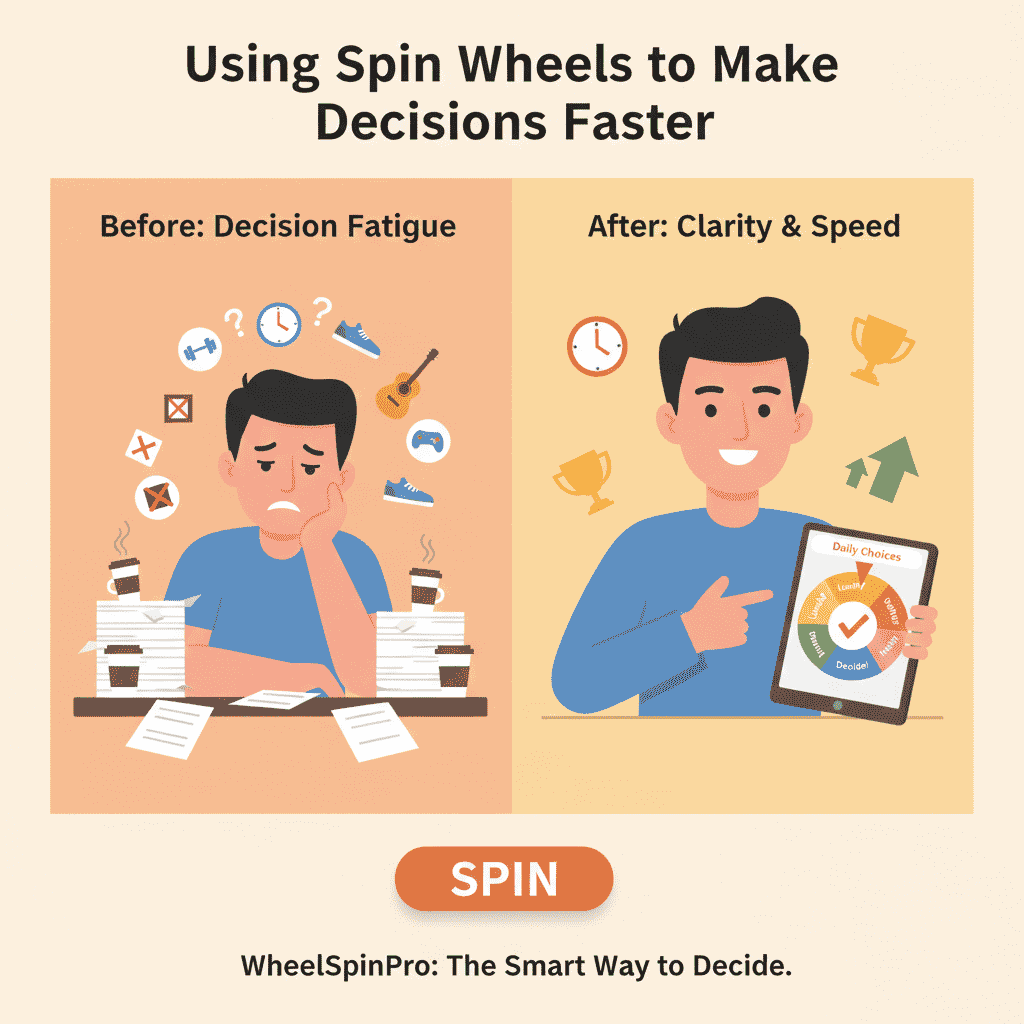
Using Spin Wheels to Make Decisions Faster: The Case for Cognitive Offloading
Most people believe that more deliberation produces better decisions. The research says otherwise — at least for a specific, common category of choices. Here's the cognitive science case for deciding faster, and why a spin wheel is often the most rational tool for the job.
There is a persistent intuition that careful deliberation always improves decisions. That the right response to a difficult choice is to think longer, consider more angles, and weigh options more thoroughly. This intuition feels responsible. It also has a hidden cost that most people systematically underestimate.
Deliberation consumes time, mental energy, and emotional bandwidth. For decisions where all available options are acceptable and the primary goal is resolution rather than optimization, these costs are real — and they are paid without a corresponding benefit in outcome quality.
A spin wheel makes a different offer: offload the decision to a neutral random mechanism, resolve it in seconds, and redirect the cognitive resources you preserved toward choices that actually benefit from them.
This is not laziness. It is cognitive resource management — a deliberate strategy for improving decision quality where it matters by reducing waste where it doesn't. This article explains the science behind it, the practical contexts where it applies, and the framework for knowing when spinning is the right call.
The Real Cost of Slow Decisions (It's Not What You Think)
When people estimate the cost of a slow decision, they typically focus on the time lost. But time is only one dimension of the cost — and often not the most significant one.
The Opportunity Cost of Deliberation
Every minute spent deliberating over a low-stakes choice is a minute not spent on tasks that require genuine judgment. This opportunity cost is invisible in the moment — it doesn't feel like you're wasting the time you could spend on something more important — but it accumulates across an entire day, week, and working life into a significant total.
Research on time-use in knowledge work consistently finds that workers underestimate the cumulative time spent on micro-decisions: which task to start next, which email to respond to first, which meeting topic to address, what to eat for lunch. Individually trivial; collectively substantial.
The Cognitive Depletion Cost
Beyond time, deliberation depletes cognitive resources — the same pool of mental capacity used for complex reasoning, self-control, and careful judgment. Roy Baumeister's ego depletion research established this conclusively: willpower, self-regulation, and deliberate decision-making all draw from a shared, finite resource that degrades with use.
This means that a five-minute deliberation over lunch options costs something at 3pm — not the five minutes, but the marginal degradation in decision quality on whatever you decide later in the day. The decision you thought was free had a hidden downstream price.
The Escalation Cost
In group settings, delayed decisions have a compounding social cost. The longer a group deliberates over an acceptable choice, the more entrenched each member becomes in their position — a phenomenon called group polarization, documented extensively in social psychology research. What could have been resolved in 30 seconds with a spin becomes harder to resolve by the minute, as the delay itself creates stakes around the outcome.
Analysis Paralysis: When More Thinking Produces Worse Decisions
Analysis paralysis — the state of overthinking a decision to the point of being unable to make it — is not a character flaw or a sign of weak will. It is a predictable output of specific cognitive conditions that can be understood and managed.
The Paradox of Choice
Barry Schwartz's research on decision-making, published in The Paradox of Choice, documented a counterintuitive finding: more options reliably produce worse outcomes for decision-makers, not better. Increasing the number of available choices increases the cognitive burden of evaluation, increases the likelihood of post-decision regret (because unchosen options remain mentally available as counterfactuals), and reduces the satisfaction with the chosen option.
This effect is strongest for what Schwartz calls "maximizers" — people who feel compelled to identify the objectively best option before committing. For choices where no objectively best option exists (because all options are acceptable), the maximizer's process is an infinite loop with no natural termination point.
Anticipatory Regret
One of the primary drivers of decision delay is anticipatory regret — the imagined experience of regretting the choice after it's made. Research shows that anticipatory regret causes people to delay decisions, to over-gather information they don't actually need, and to seek external validation for choices they are capable of making independently.
A spin wheel eliminates anticipatory regret by removing the decision-maker from the equation. If the wheel chose, there is no decision to regret — only a neutral outcome to accept. This psychological shift is measurably real: people report higher post-decision satisfaction with outcomes from neutral random processes than with identical outcomes they deliberated over, because the absence of a chosen alternative eliminates the counterfactual comparison.
Deliberation-Without-Attention
Dutch psychologist Ap Dijksterhuis's research on unconscious thought theory offers a relevant counterpoint: for genuinely complex decisions with many variables, deliberation can actually impair decision quality — because conscious processing handles fewer variables simultaneously than the unconscious mind. His studies showed that people made better choices on complex decisions after distraction (allowing unconscious processing) than after focused deliberation.
The implication: the decisions that most benefit from deliberation are not the ones people deliberate most carefully over. Simple, low-stakes choices (where to eat, what task to do next) receive excessive conscious attention; complex, high-stakes decisions (career moves, major purchases) often receive less careful processing than they deserve because they are emotionally difficult. A spin wheel for the simple decisions frees cognitive resources for the complex ones.
The Decision Speed Framework: When to Think and When to Spin
Not all decisions are appropriate candidates for a spin wheel. The key is identifying the specific characteristics that make a decision a good spin candidate — and developing the habit of recognizing them in real time.
| Decision Characteristic | Spin Wheel Appropriate? | Reasoning |
|---|---|---|
| All options are genuinely acceptable | ✅ Yes | No option is harmful or clearly inferior — resolution is the goal, not optimization |
| Options are roughly equivalent in value | ✅ Yes | No meaningful quality differential makes extended deliberation pointless |
| Decision recurs regularly | ✅ Yes | Cumulative time and cognitive cost of recurring deliberation is high; systematic randomization saves both |
| Group needs to agree but preferences differ | ✅ Yes | Neutral process resolves deadlock without social cost |
| Cost of deliberation exceeds value of any single option | ✅ Yes | More time spent deciding than the decision is worth |
| Options have meaningfully different quality levels | ❌ No | Judgment genuinely improves outcome — deliberation has ROI |
| Decision has significant risk or consequence asymmetry | ❌ No | Downside risk makes optimization worth the deliberation cost |
| Individual expertise or context determines the best option | ❌ No | Specific knowledge adds real value — random selection discards it |
| Accountability for the outcome is required | ❌ No | Someone must own and justify the decision — randomization removes accountability |
The central question is always: does deliberation improve the outcome here, or does it just delay it? For a significant proportion of daily decisions — research on time-use suggests more than half — the honest answer is that it only delays.
Personal Decision Use Cases: Where Spin Wheels Save the Most Time
The compounding effect of spin wheel use is most visible in personal contexts — where the same low-stakes decisions repeat daily and the cumulative cognitive cost is rarely recognized because each individual instance feels trivial.
Professional Decision Use Cases: High-Frequency, Low-Stakes Choices at Work
In professional environments, the spin wheel's value is not just cognitive — it is also social. In groups, the same dynamics that slow personal decisions (overthinking, preference conflicts, avoidance of appearing decisive) are amplified by organizational hierarchy, interpersonal politics, and the stakes attached to being seen as the person who made the "wrong" call.
A spin wheel removes the social dimension of these decisions by removing the human decision-maker entirely. The wheel chose — not a manager, not the loudest voice, not whoever spoke first.
| Professional Context | Recurring Decision | Why Spin Wheel Helps |
|---|---|---|
| Daily standups | Who presents first | Eliminates awkward silence; sets engaged tone for the meeting |
| Sprint planning | Which tied feature to prioritize when teams are deadlocked | Breaks genuine tie after deliberation without political fallout |
| Task rotation | Who handles recurring tasks this week | Removes manager from the assignment equation; reduces perceived favoritism |
| Meeting facilitation | Who leads the discussion or takes notes | Rotates ownership without requiring volunteers or directed assignment |
| Idea selection | Which concept to prototype first from a shortlisted set | Breaks creative deadlock; maintains team momentum without politics |
| Team schedule choices | Which day to schedule a recurring team event | Resolves preference conflicts without extended negotiation |
| Client decisions | Which account manager covers a new account when capacity is equal | Neutral assignment reduces internal friction and perceived inequity |
The Velocity Effect in Professional Settings
In agile and high-velocity work environments, the speed of decision-making is a competitive advantage. Teams that resolve procedural decisions (who presents, what gets tackled first, who owns a task) in seconds rather than minutes execute faster, maintain momentum through longer work sessions, and accumulate less decision debt — the backlog of unresolved minor choices that creates drag on major execution.
A spin wheel is one of the simplest tools for increasing decision velocity without sacrificing fairness. It doesn't just save the minutes spent deliberating — it preserves the mental state that allows the next decision to be made at full cognitive capacity.
Building a Personal Decision System With Spin Wheels
A single spin for a single decision produces a small benefit. A systematic approach — pre-built wheels for recurring decision categories — produces a compounding benefit that accumulates across an entire workday and life.
For one week, note every decision you make that: (a) recurs more than twice per week, (b) involves options you find equally acceptable, and (c) takes more than 30 seconds to resolve. These are your spin candidates. Most people identify 8–15 decision categories in this audit — and are surprised by how much cumulative time they represent.
Create a saved wheel for each recurring decision category with all currently acceptable options loaded. A meal wheel with your 10 approved options. A task wheel with your active project list. A workout wheel with your preferred exercise types. Build them once; use them indefinitely. The upfront investment is 15 minutes; the return is years of faster, lower-friction decisions.
The spin wheel only works if the result is final. Decide before spinning that the first result is accepted — not conditionally accepted depending on the outcome. A wheel you re-spin when you don't like the result is not a decision tool; it is a preference-confirmation ritual that wastes more time than the deliberation it replaced.
Wheels are only useful if their options remain current and acceptable. Review each wheel periodically — remove options that are no longer viable, add new ones that have become available. A meal wheel that includes a restaurant you now dislike or a task wheel with completed projects defeats the purpose.
The goal is not to spin for every decision — it is to identify clearly which decisions belong in the spin category and which require genuine deliberation, and to execute that distinction consistently. The discipline is in the categorization, not in the spinning. Spin fast for symmetric decisions; think carefully for asymmetric ones.
Why People Accept Spin Wheel Outcomes — Even When They Wouldn't Have Chosen Them
One of the most consistent findings in research on random selection is that people accept neutral random outcomes at higher rates than they accept equivalent outcomes produced by human choice — even when the outcomes are identical. This effect is documented across contexts from judicial decisions to classroom participation to household task allocation.
Several psychological mechanisms explain it:
No Counterfactual Human Choice to Resent
When a human makes a decision that doesn't favor you, you can construct a narrative: they were biased, they had a reason, they chose against you deliberately. When a wheel decides, none of these narratives are available. There is no agent to attribute intent to, no relationship dynamic to strain, no favoritism to perceive. The result is simply what happened — and acceptance follows more readily.
Reduced Post-Decision Regret
Research by Daniel Gilbert on affective forecasting shows that people systematically overestimate how much they will regret outcomes that weren't their choice — and underestimate how quickly they adapt to and accept them. The anticipatory regret that prevents commitment to a choice is largely absent when the choice was made by a neutral mechanism: you couldn't have chosen differently, so there is nothing to regret.
The Fairness Signal
A visible spin — particularly one performed in front of others — creates a fairness signal that unilateral human decisions cannot replicate. Procedural justice research consistently shows that the perceived fairness of the process by which an outcome was reached is as important to satisfaction and acceptance as the outcome itself. A spin wheel is a procedural fairness tool — it makes the process visibly neutral in a way that human judgment never can be.
Common Objections to Using Spin Wheels for Decisions — Addressed
"Isn't this just avoiding responsibility?"
Only if you use it for decisions that require accountability. A spin wheel is appropriate for symmetric decisions where all options are acceptable — situations where there is no "right" answer that judgment could identify. Using a wheel to decide which of five equally valid tasks to start with is not avoiding responsibility; it is efficiently allocating cognitive resources. Using a wheel to decide a high-stakes business strategy would be.
"What if the wheel picks something I don't want?"
If you find yourself reluctant to accept a result, it is a useful signal: either the option on the wheel shouldn't have been there (in which case, remove it before spinning next time), or you actually do have a preference that deliberation would surface (in which case, deliberate rather than spin). The wheel's value is in decisions where any result is genuinely acceptable — not in suppressing preferences you didn't know you had.
"Doesn't randomness produce suboptimal outcomes?"
For asymmetric decisions — where options have meaningfully different value — yes. But for symmetric decisions, "suboptimal" is not a meaningful concept: all options are acceptable by definition. The cost of any specific outcome is negligible; the cost of prolonged deliberation is real. Randomness produces the optimal outcome for this category of decision because the optimal outcome is any outcome, quickly.
"I already make quick decisions — why do I need a wheel?"
Quick decisions made independently are not the same as random decisions. A person who "quickly" picks the same restaurant every time they can't decide is not deciding quickly — they are defaulting to availability bias. A wheel removes the bias that makes fast manual decisions unfair in group settings, and provides the commitment mechanism that makes decisions stick rather than being relitigated.
Using WheelSpinPro as a Daily Decision Tool
WheelSpinPro is designed for exactly the use pattern described in this article — pre-built wheels for recurring decision categories, accessible instantly, without friction between needing a decision and making one.
- Pre-built saveable wheels — create your meal wheel, task wheel, and team rotation wheel once; access them in seconds whenever they're needed
- Multiple spinner formats — Classic Wheel for standard multi-option decisions, Coin Toss for binary choices, Dice Roll for numbered selections
- Results history tracking — for recurring decisions where fair rotation matters (chores, task assignment), log previous results and remove recent selections to ensure genuine long-term fairness
- Works on any device — phone, tablet, desktop; no installation, no account required to spin; as close to zero friction as a decision tool can be
- Fast entry for ad-hoc decisions — for decisions you haven't pre-built a wheel for, enter options and spin in under 60 seconds
For workplace teams specifically, see our guide on how spin wheels improve team productivity — covering meeting facilitation, task rotation, and participation equity in professional settings.
Final Thoughts: Faster Isn't a Compromise — It's the Optimal Strategy
The conventional wisdom is that good decisions take time. For complex, asymmetric, high-consequence decisions, this is true. For symmetric, low-stakes, recurring decisions, it is not only untrue — it is actively counterproductive.
Every minute spent deliberating over a choice where any outcome is acceptable is a minute of cognitive capacity that doesn't go toward a decision that would actually benefit from it. Every five-minute group debate over who goes first in a meeting is five minutes of collective energy that could have been one spin.
A spin wheel is a cognitive offloading tool — a mechanism for removing the decision-making burden from the human mind at exactly the moments when that burden produces cost without benefit. Used systematically, it doesn't just save time. It preserves decision quality across an entire day by keeping your best thinking available for your most important choices.
That is not a shortcut. That is a strategy.
📎 Related Articles on WheelSpinPro
- Why Fair Decision-Making Matters — And How Randomization Fixes It — the psychology of procedural fairness and why process transparency builds trust
- Spin Wheels vs. Manual Decision Making — the cognitive science behind why randomization outperforms human selection for symmetric choices
- How Spin Wheels Improve Team Productivity — workplace-specific applications and meeting facilitation use cases
- Using Spin Wheels for Events and Team Building — group decision dynamics at events and workshops
- All WheelSpinPro Tools — Classic Wheel, Coin Toss, Dice Roll, and more for every decision format
Frequently Asked Questions
📚 External References
- Schwartz, B. (2004). The Paradox of Choice: Why More Is Less — HarperCollins. Research establishing that increased choice options produce worse decision outcomes, greater post-decision regret, and lower satisfaction — the foundational work on analysis paralysis and the maximizer/satisficer distinction. HarperCollins
- Baumeister, R. F., et al. (1998). Ego Depletion: Is the Active Self a Limited Resource? — Journal of Personality and Social Psychology. Primary research establishing that willpower, self-control, and deliberate decision-making draw from a shared finite cognitive resource that degrades with use. APA PsycNet
- Gilbert, D. T. & Wilson, T. D. (2000). Miswanting: Some Problems in the Forecasting of Future Affective States — in Feeling and Thinking: The Role of Affect in Social Cognition. Research on affective forecasting errors, including why people overestimate post-decision regret and underestimate psychological adaptation to unchosen outcomes. Harvard Scholar

Written by the maker of Wheel Spin Pro
The developer behind Wheel Spin Pro's spin engines and 140+ unique pickers, writing practical guides on fair random selection for classrooms, giveaways, and events. More about the project.