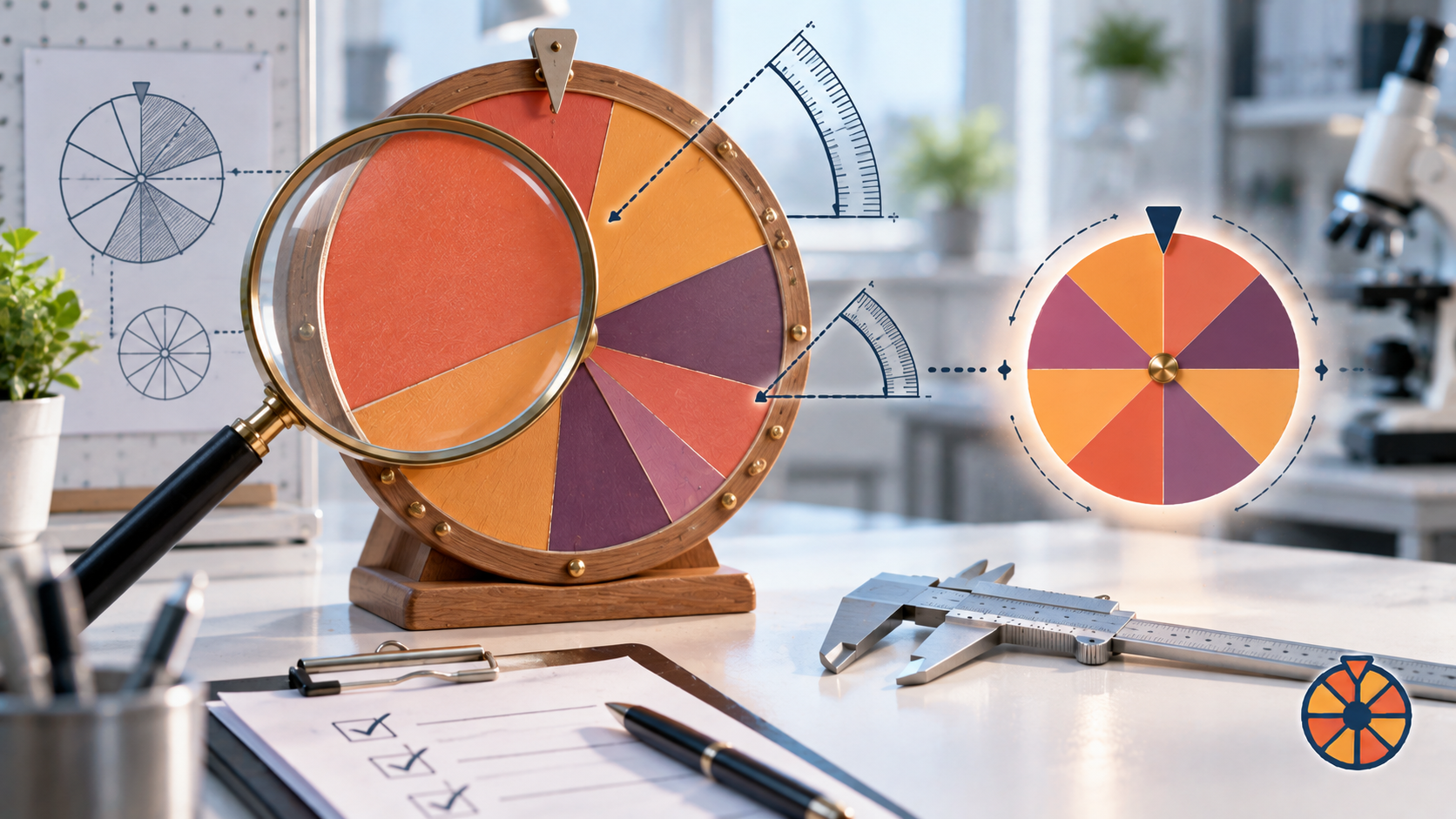
Are Online Spin Wheels Rigged? How Weighted Slices Really Work and How to Check One
Most are not. But a fair wheel and a weighted wheel are two different things, and a weighted wheel is only dishonest when the weights are hidden. Here is how to tell which one you are looking at, in about a minute.
- Nearly every spin wheel picks the winner first from a random number, then rotates the animation to land on it. That is normal engineering, not cheating.
- A weighted wheel is not a rigged wheel. It is rigged when the odds sit in a hidden field the picture does not show you.
- On an honestly drawn wheel the slice angle is the odds. Weights 5, 3 and 2 mean 50%, 30% and 20%: 180, 108 and 72 degrees.
- Spin-to-win popup builders document a per-slice probability field. MailerLite's help page says it can be set "even 0%", which is how a visible prize becomes an unreachable one.
- Fifty spins and a chi-square test catch a wheel that is off by tens of points, and completely miss one that is off by seven.
- The only real proof is a commitment published before the spin, recheckable afterward at /verify.
The suspicion is reasonable. You spin a wheel with eight prizes on it, you get the 10% off coupon, and something about the way the wheel slowed down felt decided. The grand prize slice was right there. It passed under the pointer twice. Then the wheel drifted past it and settled on the coupon, the way it always does.
The honest answer has three parts, and only one is comfortable. Most wheels on the open web are not rigged in the sense you mean. Almost all of them, including the ones on this site, do decide the winner before the animation runs, which sounds damning until you see why every wheel has to work that way. And one category, the spin-to-win popup, ships with a documented setting that hands any slice any probability at all, including zero, while still drawing it on the wheel.
Are online spin wheels rigged?
Usually not, but the question is slightly wrong. The thing to ask is whether the wheel is weighted and whether it tells you. A wheel that gives one slice a 50% chance is not cheating you if that slice is drawn at half the circle. A wheel that gives one slice a 50% chance while drawing all eight slices the same size is showing you a picture that is not true.
Those two get confused constantly. "Rigged" implies the outcome is chosen for you by someone with an interest in it. "Weighted" just means the outcomes are not equally likely, which is often exactly what you want. A trade show wheel that gave away the television one spin in eight would not last the morning.
The dishonest move is not the weighting. It is the gap between what the wheel does and what the wheel shows:
| What the wheel is | What it looks like | Is it honest? |
|---|---|---|
| Equal slices, equal odds | Eight identical wedges, each 45 degrees | Yes. The picture is the whole truth. |
| Weighted slices, angles match the weights | One big wedge, several small ones | Yes. You can read the odds off the picture with a protractor. |
| Weighted odds, equal-looking slices | Eight identical wedges, hidden probability field | No, unless the odds are published elsewhere. |
| Predetermined outcome ignoring the draw | Anything at all | No. This is the actual "rigged" case, and it is rare. |
The fourth row is what people picture when they say rigged, and it is the rarest of the four: the most work and the easiest to catch. Rows two and three are where the real world lives, and row three is the one worth knowing how to spot.
A fifth thing is missing from the list because it is not real: the idea that a wheel is "due" to land on the big prize because it has not landed there lately. Each spin is an independent draw, and a wheel with no memory cannot owe you anything. That is the gambler's fallacy, covered in spin wheels for fair prize distribution.
How does a spin wheel actually pick a winner?
It draws a random number first, converts that number into a winning entry, and only then computes the angle that will bring the pointer to rest on that entry. The animation is choreography around a decision that has already been made. This is how essentially every digital wheel works, and it is not cheating. It is the only design a stranger can verify.
Here is the sequence, taken from the wheel engine that runs the wheels on this site, a plain JavaScript file you can read in your browser's developer tools.
Why the winner has to come first
The intuitive design is the opposite: give the wheel a random shove, let the physics decide, read off the slice under the pointer. That feels more honest, the way a coin tossed in the air feels more honest than a number read off a screen. On a screen it is strictly worse, for a reason that only appears when you try to prove anything.
A wheel on a page does not reset between spins. It comes to rest wherever the last spin left it, so if the random number seeds the shove, the winner depends on the wheel's previous resting angle: a floating-point number nobody recorded, tied to the pixel geometry of the canvas, that would have to appear in any proof of fairness. It cannot sensibly go into a receipt, so the receipt could not be checked. The site's engine notes carry a blunt warning about this, because an earlier version did exactly that and its receipts were unverifiable.
Choosing the entry first collapses the problem. The proof then holds a random number and a list of entries and nothing about rendering: no pointer position, no drawing order, no slice geometry, no previous angle. Anyone can recompute the winner with a text editor and a hash calculator.
You can confirm this without reading code. Start a spin, then interfere: switch tabs, drag the window, throttle the animation. It still lands on the same slice, because the slice was chosen before the first frame rendered. If interfering could change the result, the result would depend on your CPU speed, which is a far worse property than being decided early.
What does it mean for a wheel to be weighted?
It means the entries are not equally likely. Three entries on a wheel do not have to be 33.3% each. If you give them weights of 5, 3 and 2, the total is 10, so the odds are 5/10, 3/10 and 2/10: 50%, 30% and 20%. On a correctly drawn wheel those become 180, 108 and 72 degrees of the circle, and the picture tells you the odds without anyone having to say them out loud.
The arithmetic is the whole basis of the 60-second check further down, so it is worth doing slowly. A circle has 360 degrees. A weight becomes a share by dividing it by the total of all weights, and that share becomes an angle by multiplying by 360.
| Entry | Weight | Share of the total | Probability | Slice angle |
|---|---|---|---|---|
| Prize A | 5 | 5 ÷ 10 | 50% | 0.50 × 360 = 180° |
| Prize B | 3 | 3 ÷ 10 | 30% | 0.30 × 360 = 108° |
| Prize C | 2 | 2 ÷ 10 | 20% | 0.20 × 360 = 72° |
| Total | 10 | — | 100% | 360° |
Compare the same three entries unweighted: 360 ÷ 3 = 120 degrees each, 33.3% each. Prize A goes from a third of the wheel to half of it, and you can see the difference from across the room. That visibility is the point.
Weighting is often the fair choice
It is easy to read "weighted" as "cheating" and stop there. In plenty of situations equal odds are the unfair option.
The test is not "is it weighted". The test is "can the person spinning it find out". If the odds are drawn into the circle, published beside it, or recorded in a receipt, weighting is a feature. If none of those is true, the wheel is a picture that means nothing.
Where do rigged wheels really exist?
In promotional spin-to-win popups, where each slice's probability is a separate configuration field the visitor never sees. This is not a secret or an accusation: it is a documented, advertised feature of the popup builders themselves, and one vendor's help page states plainly that a slice's probability can be set to 0%.
MailerLite's help documentation for its spin-the-wheel popup form describes a wheel of "4 to 8" slices, each carrying three separate fields: a placeholder (the prize name), a discount code, and "Probability: A percentage indicating how likely it is for the wheel to land on that slice." It notes that "all slices' percentages combined must total 100%" and advises that "if you don't want to show losing slices often, set their probability to a lower percentage (or even 0%)."
Read that last clause again. A slice can be drawn on the wheel, labeled with a prize, spun past by the pointer, and carry a probability of zero. The documentation says nothing about a slice's drawn size following its probability, which is the crux: the probability lives in a field, and the visitor sees a wedge.
Claspo's guide is equally direct, saying you "can set spin the wheel discounts of various sizes and specify the percentage of probability of winning for each option", and recommends low-tier rewards at "60-70% of spins", mid-tier at "15-20%", and high-tier rewards such as a large gift card "usually rare", at an "acceptable frequency" of "5-10% of spins".
There is nothing sinister in a 5% grand prize; a business can only afford to display a $500 gift card at all because the odds are low. The problem is narrower. The wheel shows eight equal-looking wedges, one worth $500 and one worth nothing, and a visitor with no other information assumes both are one in eight.
Two signs of a hidden-odds wheel
The first is equal wedges holding unequal prizes. Eight identical slices where one is a television and one is "Try again" tells you the drawing is decorative; on a wheel that draws its odds the television slice would be a sliver. The second is repetition across independent visits: open the popup in a private window, on a phone, from a different network. If an eight-slice wheel hands out the same coupon on six separate visits, the chance of that on an even wheel is (1/8)5, about one in 32,768.
Regulators care about the same thing. In US telemarketing, the Telemarketing Sales Rule requires a seller running a prize promotion to disclose "the odds of being able to receive the prize, and, if the odds are not calculable in advance, the factors used in calculating the odds". That rule governs phone calls rather than website popups. It is quoted for what it treats as material: not whether the odds are long, but whether they are stated.
If you build these popups, the fix is not to abandon weighting. It is to publish the odds beside the wheel, or draw the slices at the size the odds imply. The marketing side of that trade-off is in how to use spin-the-wheel popups to generate leads and spin the wheel vs discount coupons.
How do you check any wheel in 60 seconds?
Four checks, in this order: measure the slice angles, look for published odds, look for a verifiable receipt, and if you still cannot tell, spin it fifty times and count. The first three take seconds.
Count the slices and divide 360 by that number. Any slice visibly bigger or smaller than 360 ÷ n is a weighted wheel telling you so. Eight identical wedges holding eight very different prizes is a wheel to be curious about.
Terms, official rules, a tooltip, a line under the wheel. A wheel publishing "grand prize: 1 in 500" is more honest than one with eight equal slices and no text, even though its odds are far worse.
A fingerprint shown before the spin, a seed revealed after it, and an independent page that recomputes the winner is the only thing that proves anything. A "certificate" generated after the result, containing a hash of the winner, proves nothing. That scheme is taken apart in provably fair, explained.
If the wheel is free to spin, spin it 50 times, tally the results, and run the chi-square test below. It will not prove a wheel is fair. It will catch one that is badly off.
Step 1 has a subtlety: some wheels draw equal slices and disclose their weights in a panel, which is honest but easy to miss. The angle test tells you which world you are in, not that anyone is doing something wrong.
How do you run a chi-square test on 50 spins?
Tally how many times each entry came up, work out how many times each one should have come up, and add up (observed − expected)² ÷ expected across the entries. Compare the total with a table value. With three entries the threshold is 5.991. Below that, the wheel is consistent with the odds you tested; above it, it is not.
The NIST/SEMATECH Engineering Statistics Handbook gives the statistic as χ² = Σ (Oi − Ei)² ÷ Ei, summed over the k categories, with k − c degrees of freedom, where c is the number of estimated parameters plus one. Testing against a fully specified claim (equal odds, or a published 50/30/20) estimates nothing, so c = 1 and the degrees of freedom are k − 1. You reject the claim when χ² exceeds the critical value.
A worked example, all of it arithmetic
Say you spin a three-slice wheel 50 times and get this:
| Entry | Observed | Expected if equal (50 ÷ 3) | (O − E)² ÷ E | Expected if 50/30/20 | (O − E)² ÷ E |
|---|---|---|---|---|---|
| Prize A | 30 | 16.67 | 13.33² ÷ 16.67 = 10.667 | 25 | 5² ÷ 25 = 1.000 |
| Prize B | 12 | 16.67 | 4.67² ÷ 16.67 = 1.307 | 15 | 3² ÷ 15 = 0.600 |
| Prize C | 8 | 16.67 | 8.67² ÷ 16.67 = 4.507 | 10 | 2² ÷ 10 = 0.400 |
| Total | 50 | 50 | χ² = 16.48 | 50 | χ² = 2.00 |
Three categories, so 3 − 1 = 2 degrees of freedom. The NIST table of critical values gives 5.991 at the 5% significance level for 2 degrees of freedom (and 4.605 at 10%).
Now read both columns. Against "all three are equally likely", χ² = 16.48, comfortably past 5.991: those 50 spins are not consistent with an even wheel. Against "the odds are 50/30/20", χ² = 2.00, nowhere near it: the same 50 spins are entirely consistent with the published weighting.
That is the most useful thing about this test. Chi-square does not measure fairness; it measures agreement with a stated claim. A weighted wheel that publishes its weights passes. The identical wheel that publishes nothing and lets you assume equal odds fails. The data never changed; the claim did.
How many spins do you actually need?
Far more than fifty for anything subtle. Fifty spins on a three-slice wheel will reliably catch a wheel that is off by twenty points. It will completely fail to catch one that is off by seven, even when the wheel behaves exactly as expected. Here is the arithmetic that shows it.
Take a wheel genuinely tilted to 40 / 30 / 30 while claiming to be even, and suppose 50 spins land exactly on its own average: 20, 15 and 15. Expected under the claim is 16.67 each. So (20 − 16.67)² ÷ 16.67 = 11.11 ÷ 16.67 = 0.667, and each of the two 15s contributes (1.67)² ÷ 16.67 = 2.78 ÷ 16.67 = 0.167. Total χ² = 0.667 + 0.167 + 0.167 = 1.00.
One, against a threshold of 5.991. A wheel deliberately tilted seven points toward one prize, behaving exactly on its average, produces a chi-square of 1.00 over 50 spins. Fifty spins cannot see it.
Every term in the sum scales with the number of spins, so doubling the spins doubles the statistic. Detecting a seven-point tilt on a three-slice wheel needs around 400 spins in the best case, and more on a bad day, since real counts scatter around the average rather than sitting on it.
| Spins | χ² for a 40/30/30 wheel landing on its average, tested against equal odds | Threshold (2 df, α = 0.05) | Verdict |
|---|---|---|---|
| 50 | 1.00 | 5.991 | Passes. Tilt invisible. |
| 100 | 2.00 | 5.991 | Passes. Tilt invisible. |
| 200 | 4.00 | 5.991 | Passes. Tilt invisible. |
| 400 | 8.00 | 5.991 | Fails. Tilt detected. |
Two practical notes. Keep enough spins that every entry is expected several times over: three entries and 50 spins expects about 17 each, but 50 spins across a 20-slice wheel expects 2.5 per slice and the test becomes useless. And a passing chi-square says "these counts do not contradict the claim", not "the wheel is fair".
This is why counting is the last resort rather than the first. It is a sanity check for a wheel you can spin freely, and no use against a popup that allows one spin per visitor, which is exactly where you most want to know. There, the only levers left are published odds and a receipt.
What does a trustworthy wheel show you?
Three things, in increasing order of strength: the weights, visibly, in the drawing or in a panel you can open; the odds, published in words; and a receipt whose commitment was published before the spin and which an independent page can recheck. A wheel with all three is not asking for trust at all.
The third is the only one that survives a genuinely dishonest operator, so it is worth understanding properly. The scheme is called commit-and-reveal. Before the draw, the page generates a secret seed and shows you a SHA-256 fingerprint of it. The fingerprint pins down the seed without revealing it, and no seed can be found afterward to match a fingerprint chosen earlier. The numbers for the spin come from hashing that seed with a client seed and a counter. After the spin the seed is revealed, and you check two things: that it really does hash to the fingerprint shown before the spin, and that hashing it reproduces the number that chose the winner. If either fails, something was swapped. Full walkthrough in provably fair, explained, and the underlying randomness in what is a random number generator.
For a giveaway with real value attached, this is the difference between a result people accept and one they argue about. Running one end to end is covered in fair giveaways and contests using online spin wheels.
How does Wheel Spin Pro handle weighted entries?
The Weight % field appears on the classic wheel, and what you type in it does two things at once: it sets the slice's drawn angle and it sets the slice's odds, because they are the same number in the code, as long as the percentages add up to 100 or some entries are left blank to share the rest. The weights are then written into the fairness receipt, so a verifier recomputes the winner using the weights that were in force.
Everything below is from the engine source, and it is worth being precise about what is confirmed.
Each slice is drawn with an arc of (percent ÷ 100) × 2π radians. That is the drawing code and the only source of a slice's size, so a slice at 50% is drawn at exactly half the circle. There is no separate "visual size" setting that could diverge from it.
The winner is chosen by laying the entries end to end in proportion to those percentages and dropping a random mark on the line. The fraction is laid against the cumulative percentages rather than divided by the item count, which is what keeps the odds exact. The verification page calls the same function, so the wheel and the proof cannot drift apart.
Weight some entries and leave others blank, and the remainder of 100% is split evenly among the blanks. Type weights adding to more than 100 and they are rescaled in proportion. Set none and the round is recorded as having no weights, which is how a verifier reads a receipt with none.
A sealed receipt carries the entry list and the weight list as they stood at the moment of the spin, alongside the commitment, the revealed seed and the announced winner. Changing the weights afterward cannot make an old receipt verify.
Sealing refuses unless the announced winner is exactly the entry the committed draw selected, so a disagreement yields no proof rather than a false one.
Two honest caveats. The Weight % input is exposed on the classic wheel and not on the themed wheels, so the prize wheel, the giveaway wheel and the rest run the same engine at equal odds. And none of this proves the site is honest in general. It describes what the code in your browser does, which you can read yourself, and makes any single spin checkable by a stranger. Both are narrower claims than "trust us", deliberately.
So, is the wheel out to get you?
Almost certainly not, and the parts that look suspicious are usually the parts engineered correctly. A wheel that picks the winner before it animates is doing the only thing that makes the result checkable. A wheel with one big slice and two small ones is stating its odds out loud. Neither is a red flag.
The real signal is duller: a wheel showing you a picture it does not use. Eight equal wedges, wildly unequal prizes, no odds published anywhere, and a probability field in a panel you will never see. Nothing about that is illegal in most places, and plenty of businesses run it with no bad intent, having accepted the builder's defaults. But it is the one arrangement where what you see and what happens are different things.
So use the sixty-second version. Count the slices and divide 360 by that. Look for odds in writing. Look for a commitment published before the spin. And if the wheel is free, spin it fifty times, add up (observed − expected)² ÷ expected, and compare it with 5.991.
Related reading on Wheel Spin Pro
- Provably Fair, Explained for Normal People — the commit-and-reveal receipt in full.
- What Is a Random Number Generator? — where the number that picks the slice comes from.
- Fair Giveaways and Contests Using Online Spin Wheels — running a draw people accept afterward.
- Spin Wheels for Fair Prize Distribution — why a wheel is never "due".
- Is a Coin Flip Really 50/50? — the same question, asked of a two-slice wheel.
- How to Use Spin-the-Wheel Popups to Generate Leads — the marketing side, and where odds belong.
Frequently Asked Questions
Sources
- MailerLite. Spin the wheel pop-up form. MailerLite Help Center. Documents the per-slice Probability field, the requirement that slice percentages total 100%, and the option to set a slice to 0%.
- Claspo. Spin-the-Wheel Popup: Guide and How to Make One. Claspo. Describes specifying the percentage probability of winning for each option and recommends 5-10% of spins for high-tier rewards.
- NIST/SEMATECH (2012). 1.3.5.15 Chi-Square Goodness-of-Fit Test. e-Handbook of Statistical Methods. The test statistic, the degrees of freedom and the rejection rule.
- NIST/SEMATECH (2012). 1.3.6.7.4 Critical Values of the Chi-Square Distribution. e-Handbook of Statistical Methods. Upper-tail critical values: 5.991 at 2 df and α = 0.05; 4.605 at 2 df and α = 0.10.
- US Federal Trade Commission. 16 CFR § 310.3(a)(1)(iv), Telemarketing Sales Rule. Legal Information Institute, Cornell Law School. Requires disclosure of "the odds of being able to receive the prize" in a prize promotion.

Written by the maker of Wheel Spin Pro
The developer behind Wheel Spin Pro's spin engines and 140+ unique pickers, writing practical guides on fair random selection for classrooms, giveaways, and events. More about the project.