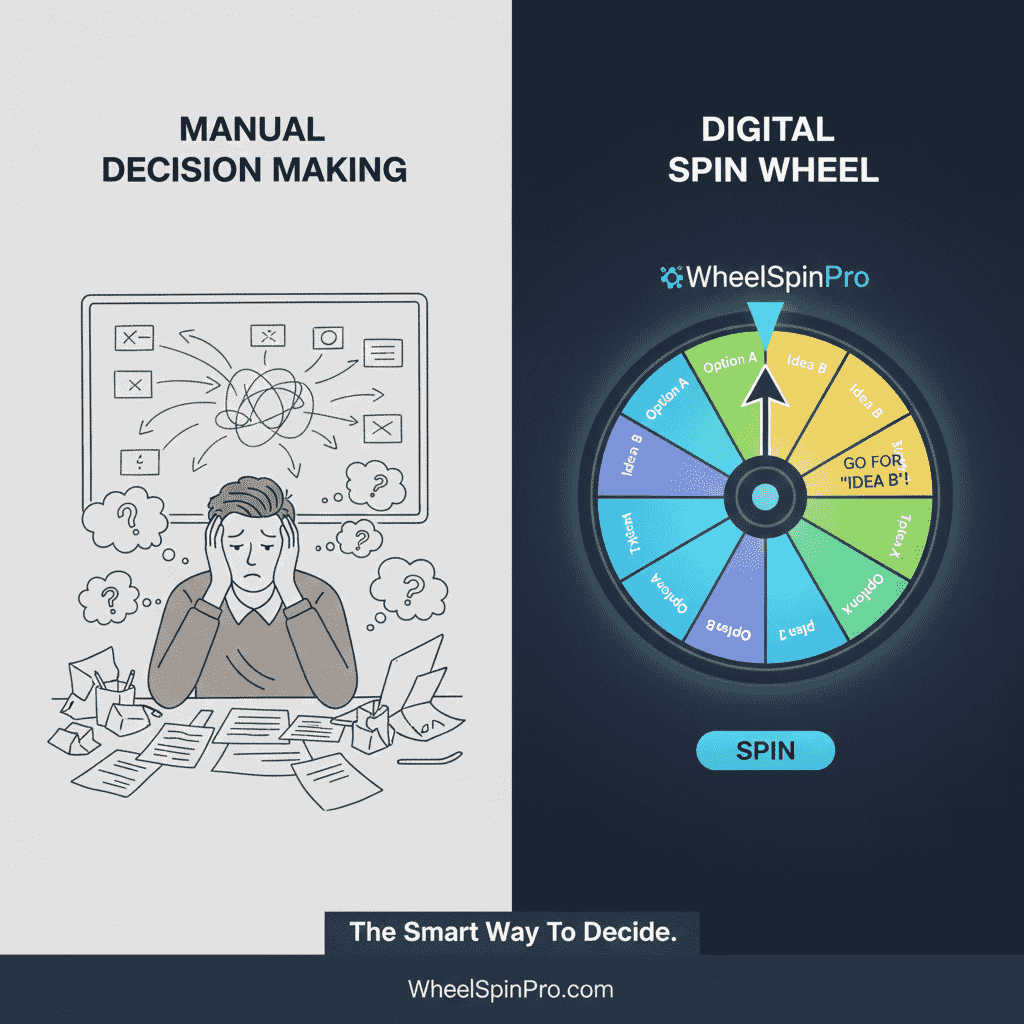
Spin Wheels vs. Manual Decision Making: Why Randomization Wins (For the Right Choices)
Manual decision-making feels thorough. It often isn't. For a specific, predictable category of choices, the human brain is slower, less fair, and more exhausted by the process than a simple spin wheel — and cognitive science explains exactly why.
We tend to assume that more human involvement in a decision means a better outcome. But this assumption quietly breaks down for a huge category of everyday decisions — choices where all options are acceptable, where extended deliberation adds no value, and where the real cost isn't making the wrong call, but making any call slowly.
For these decisions, manual selection doesn't just waste time. It introduces a predictable set of cognitive distortions — bias, fatigue, and social pressure — that make the outcome less fair and the process more draining than it needed to be.
A spin wheel sidesteps all of it. Not because randomness is inherently superior to judgment, but because for symmetrical, low-stakes choices, randomness is provably more neutral, faster, and better received by everyone involved.
This article makes the case precisely — explaining what goes wrong with manual decisions, why spin wheels fix it, and exactly where the line is between decisions that benefit from randomization and those that genuinely require human judgment.
What "Manual Decision Making" Actually Involves (And Where It Goes Wrong)
When we say someone is making a decision "manually," we mean they are applying conscious deliberation — weighing options, drawing on memory and experience, factoring in preferences and context, and arriving at a choice. For complex decisions with asymmetric outcomes, this is exactly the right approach.
But for low-stakes, symmetric decisions — choosing the meeting opener, assigning a recurring task, picking a game, settling a group tie — the manual process introduces five compounding problems that have nothing to do with the quality of the options themselves:
A spin wheel doesn't just solve one of these problems. It eliminates all six simultaneously — because it replaces the human cognitive process entirely for the duration of that decision.
The Cognitive Bias Problem: Why Manual Selection Is Never Truly Neutral
The idea that a thoughtful, well-intentioned person can make a fully neutral choice between options is contradicted by decades of cognitive psychology research. Several biases operate automatically and consistently in manual decision-making:
Availability Heuristic
Options that come to mind most easily are rated as more likely or more appropriate — not because they're objectively better, but because they're more mentally accessible. In task assignment, this means whoever was most recently discussed or most visible in a recent meeting gets selected disproportionately often.
Status Quo Bias
People prefer existing arrangements over change, even when change would be beneficial. In recurring decisions — who leads the standup, who handles a particular client, who goes first — the person who did it last time becomes the path of least resistance.
Affinity Bias
Decision-makers consistently favor people they know, trust, or share characteristics with. In team environments, this creates invisible skill development gaps: some members receive stretch opportunities repeatedly while others are overlooked without any deliberate intent.
Anchoring
The first option mentioned in a group discussion has an outsized influence on the final choice — a phenomenon documented consistently since Tversky and Kahneman's foundational work on heuristics and biases. In practice, this means whoever speaks first in a meeting shapes the group's decision, regardless of whether their suggestion was the best one.
Decision Fatigue: The Compounding Cost of "Just One More Choice"
Decision fatigue is not a metaphor for tiredness. It is a documented psychological phenomenon with measurable behavioral effects. Roy Baumeister's research on ego depletion established that self-control, willpower, and deliberate decision-making all draw from a shared cognitive resource — and that resource depletes with use.
The implications are practical and immediate. A manager who has already made thirty decisions before lunch — about priorities, emails, hiring questions, resource allocation — is not making their thirty-first with the same quality of cognitive processing as their first. And critically, the thirty-first decision may be entirely trivial: who presents first in the afternoon meeting.
"The will to make careful decisions is exhaustible. And once it's depleted, the brain defaults to two failure modes: impulsive choices, or avoidance of decision altogether."
— Adapted from Baumeister et al., Ego Depletion: Is the Active Self a Limited Resource?
This is precisely why trivial decisions late in the day produce disproportionate conflict. People don't argue intensely about what to watch tonight because the stakes are high — they argue because their cognitive filters are down and their patience is thin.
A spin wheel doesn't just resolve that argument in three seconds. It saves the cognitive bandwidth that would have been spent on it for decisions that actually require deliberation.
Speed and Clarity: The Measurable Advantage of One Spin
Beyond bias and fatigue, there is a straightforward operational argument for spin wheels: they are dramatically faster than group deliberation for equivalent-quality decisions.
| Decision Type | Manual Deliberation Time | Spin Wheel Time | Quality Difference |
|---|---|---|---|
| Who presents first at standup | 30–90 seconds of silence/negotiation | 5 seconds | None — outcome equally arbitrary |
| Which idea to prototype first (tied vote) | 5–15 minutes of re-debate | 5 seconds | None — both were already approved |
| Who handles a recurring task this week | 2–5 minutes of assignment discussion | 5 seconds | Spin wheel is fairer (no bias) |
| What the team eats for lunch | 5–20 minutes, unresolved | 5 seconds | Spin wheel eliminates resentment |
| Prize draw winner | Minutes of justification needed | 5 seconds, fully transparent | Spin wheel is more trusted |
The consistent pattern: for decisions where options are equivalent in value, the manual process takes anywhere from 6x to 240x longer than a spin — with no improvement in outcome quality, and often a worse experience for everyone involved.
Why Perceived Fairness Matters as Much as Actual Fairness
Organizational psychology distinguishes between substantive fairness (whether an outcome is objectively equitable) and procedural fairness (whether the process that produced it was perceived as fair). Research consistently shows that procedural fairness has equal or greater impact on satisfaction and trust than the outcome itself.
This matters enormously in group settings. When a human makes a decision — even a genuinely unbiased one — others cannot verify it was unbiased. Doubt persists. Over time, even small perceived injustices accumulate into real morale problems.
A visible spin wheel solves this differently from any manual method, because the process is transparent, participatory, and non-human. Everyone in the room watches the same unpredictable event. No one chose against anyone. The wheel is the third party that everyone already agreed to trust.
The Social Psychology of "The Wheel Decided"
When an outcome comes from a spin wheel, the social dynamic shifts fundamentally. There is no one to resent, no agenda to question, no relationship to strain. Losers accept outcomes from neutral processes at significantly higher rates than outcomes from human judgment — even when the outcomes are statistically identical. This isn't a small effect. It's the difference between a team that moves forward and one that quietly nurses a grievance.
The Decision Framework: When Randomization Beats Deliberation
The case for spin wheels is not absolute — it's conditional. Understanding the boundary is what separates effective use from misuse.
- All options are genuinely acceptable outcomes — no option is harmful or clearly inferior
- The decision is symmetric: options have roughly equal value and the goal is resolution, not optimization
- The cost of deliberation exceeds the value of selecting any one specific option
- Perceived fairness is at stake and a neutral process is needed to maintain trust
- The decision is recurring and needs to rotate equitably across people over time
- A group is stuck in a tie or deadlock after genuine deliberation has already occurred
- Options have meaningfully different risk, quality, or consequence levels
- The decision requires expertise, context, or judgment that only a human can apply
- Accountability matters — someone needs to own the choice and defend it later
- Individual preferences carry ethical, safety, or wellbeing weight
- The decision affects people who are not participants in the spin (e.g., clients, external stakeholders)
The framework is simple: if the decision needs optimizing, use judgment. If it needs resolving, spin the wheel. The ability to tell the difference is the real skill — and once you develop it, you'll find far more decisions belong in the second category than the first.
Spin Wheel vs. Manual: Real-World Scenarios Compared
Scenario 1: The Standup Deadlock
Every morning, a team of seven starts their standup with five seconds of awkward silence as no one wants to go first. The meeting hasn't even started and the group is already slightly uncomfortable. A spin wheel pre-loaded with seven names eliminates this permanently. The meeting opens with momentum instead of friction — every day.
Scenario 2: The Tied Sprint Decision
A product team has two equally valid features to build next sprint. After thirty minutes of legitimate debate, the vote is 4–4. A re-vote risks entrenching positions further. A manager picking unilaterally risks resentment. Spinning the wheel between the two options resolves it in three seconds, with both sides accepting the result because the process was visibly neutral.
Scenario 3: The Classroom Participation Problem
A teacher asks a question and waits for volunteers. The same four students raise their hands every time. Twenty-six others mentally check out. A name wheel changes this dynamic completely — everyone knows they may be called, so everyone stays engaged and prepares to answer. Research on cold-call teaching methods confirms this produces higher retention and more equitable participation than voluntary response systems.
Scenario 4: The Household Chore Dispute
In a household of adults, chore assignment through verbal negotiation reliably produces the same outcome: whoever objects least ends up doing the most. A wheel loaded with chores and names turns a recurring source of low-grade conflict into a neutral, accepted system — because no one chose against anyone. The wheel chose everyone equally.
How to Start Replacing Manual Decisions With a Spin Wheel
Audit your week. List every decision you make more than once where any outcome would be acceptable. These are your spin candidates. Common ones: who goes first, who handles a rotating task, which option to pick from a shortlist where the team is tied.
Don't build the wheel when you need it — build it during setup. A team standup wheel, a task rotation wheel, a household chore wheel. Pre-built wheels remove the last bit of friction between a moment of indecision and a resolved outcome.
Before using a spin wheel with a group for the first time, state clearly: the result is final. This commitment is what gives the process its authority. A wheel you can re-spin whenever you dislike the result is not a decision tool — it's theater.
The transparency of the spin is its legitimacy. Screen share it in remote meetings. Project it or gather around a device in person. A result announced after a private spin carries no procedural authority.
The biggest productivity gain comes from using spin wheels proactively — as a standing part of certain meeting types or household routines — not just when you're already stuck. Prevention is faster than resolution.
Why WheelSpinPro Is Built for This
WheelSpinPro is designed for decision contexts where speed, fairness, and trust matter — not just casual fun. Its features are built around the specific requirements of real-world use:
- Multiple spinner formats for different contexts — the Classic Wheel for standard group decisions, Center Spin for classroom or presentation settings, Lucky Box for prize draws
- Customizable entries — add names, tasks, or options in seconds and save wheels for reuse
- Results history tracking — essential for rotation fairness across multiple sessions
- Clean, distraction-free interface — screen-shares without visual clutter interrupting the moment
- No login required to spin — low friction for live group use
These aren't decorative features. They're the difference between a tool that genuinely replaces manual decision-making and one that just replicates it with an animation.
Final Verdict: It's Not About Replacing Judgment — It's About Protecting It
The argument for spin wheels over manual decision-making is not that humans are bad at deciding. It's that human judgment is a finite, valuable resource — and spending it on symmetric, low-stakes choices is a provably poor allocation.
Every minute your team debates who presents first is a minute not spent on a decision that actually benefits from deliberation. Every task assigned through unconscious habit is a missed opportunity to develop someone new. Every tie broken by whoever speaks loudest is a small tax on group trust.
Spin wheels don't make you less thoughtful. Used correctly, they make you more thoughtful, by concentrating your decision-making capacity where it actually matters.
That's not a novelty. That's good cognitive hygiene.
📎 Related Articles on WheelSpinPro
- Why Fair Decision-Making Matters — And How Randomization Fixes It — the psychology of procedural fairness
- How Spin Wheels Improve Team Productivity — workplace-specific applications and implementation
- Fair Giveaways and Contests Using Online Spin Wheels — transparent prize draws and competitions
- Try the Classic Spin Wheel — start making faster, fairer decisions now
- WheelSpinPro Features — full breakdown of available tools and customization options
Frequently Asked Questions
📚 External References
- Kahneman, D. (2011). Thinking, Fast and Slow — Farrar, Straus and Giroux. Foundational work on System 1 vs. System 2 thinking, cognitive biases, and the availability heuristic. Macmillan Publishers
- Baumeister, R. F., et al. (1998). Ego Depletion: Is the Active Self a Limited Resource? — Journal of Personality and Social Psychology. Primary research establishing decision fatigue and cognitive resource depletion. APA PsycNet
- Tversky, A. & Kahneman, D. (1974). Judgment under Uncertainty: Heuristics and Biases — Science, Vol. 185. The original research establishing anchoring, availability heuristic, and representativeness in human decision-making. Science.org

Written by the maker of Wheel Spin Pro
The developer behind Wheel Spin Pro's spin engines and 140+ unique pickers, writing practical guides on fair random selection for classrooms, giveaways, and events. More about the project.