How to Run a Secret Santa: Rules, Budget, Exclusions and Remote Teams
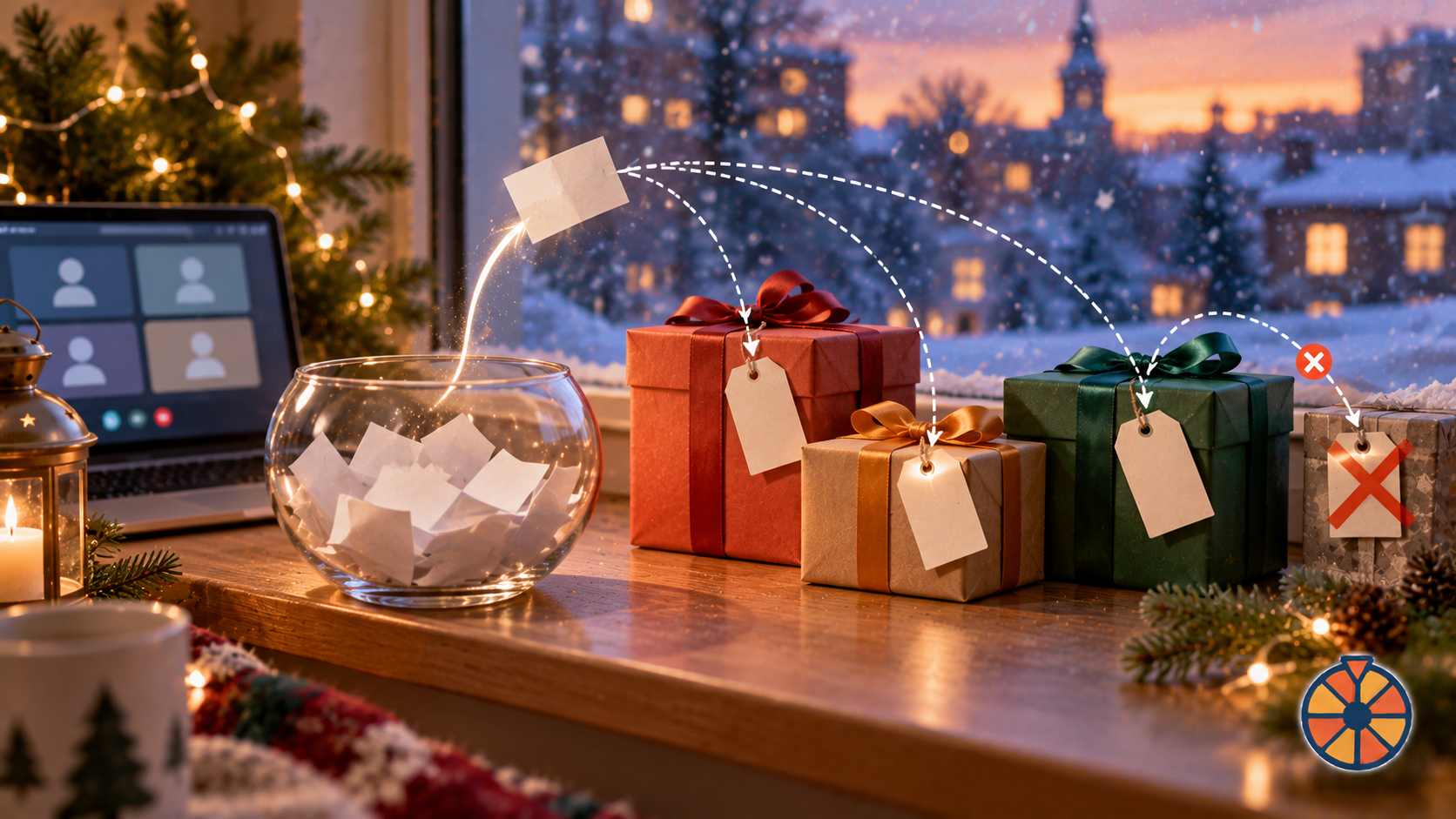
Fix the date and the budget first, collect the names, write down who may not draw whom, draw once, get everyone to post a wish list, and reveal on the day. If you use a hat, restart the whole draw on any self-draw: "just pick again" is not fair, and the arithmetic below shows why.
- Secret Santa is one gift each, one recipient each, giver kept secret. It works from 3 people up; 2 people is just swapping presents.
- Published guides put a typical budget between $15 and $50 depending on the group. Pick one number and write it on everything.
- Exclusions (couples, last year's pair, a manager and their report) are a normal part of the setup, not an awkward extra.
- A random shuffle of n names has nobody drawing themselves about 36.8% of the time (1/e). With 3 people it is exactly 2 of 6 arrangements.
- "Draw again if you get yourself" biases the result 2-to-1 in a group of three and jams on the last person one time in four. One full draw, restarted on any self-draw, is fair.
Every December somebody in every office, family and friend group becomes the Secret Santa organizer, usually by being the first to say "we should do one this year". This is the guide for that person: the rules, a timeline you can copy, the budget, couples and bosses, a draw nobody can complain about, and what to do when a colleague in another time zone has to post a parcel.
It also covers the thing most guides skip: the maths. Almost every hat draw runs with the house rule "if you pull your own name, put it back and pick again". That rule feels harmless. It is not. It changes who is likely to draw whom, and it leaves the last person at the table stuck with their own name more often than you would guess. We will count it out with three people and six slips of paper.
What is Secret Santa and what are the basic rules?
Secret Santa is a gift exchange in which each member of a group is randomly and secretly assigned one other member to buy a present for, within an agreed spending limit, and the giver's identity stays hidden until the reveal. Wikipedia defines it as a Western Christmas or Saint Nicholas tradition "in which members of a group are randomly assigned a person to whom they give a gift", and notes the giver may stay secret for good or be revealed at the end.[6]
The same game travels under many names. Wikipedia lists Kris Kringle in Australia, Canada and the Philippines, Kris Kindle in Ireland, Wichteln or Julklapp in Germany, and Amigo Oculto or Amigo Secreto in Brazil; many come from the local gift-bringer figure, such as the Austrian Christkindl.[6]
The rules every version shares:
- Everyone gives exactly one gift and receives exactly one gift.
- Nobody draws their own name.
- There is a spending limit that everyone knows before they shop.
- The giver stays anonymous at least until the gifts are opened.
- There is a fixed exchange date.
drawnames.com adds the decisions an organizer should make up front: a price limit, a date, what kind of presents are allowed (funny or thoughtful), what you expect on wrapping and labels, and whether the Santas will be revealed or stay a mystery.[2] Elfster's guide says the game "works best with at least 3 people, but there is no upper limit".[1] Two people can technically play, but the draw is forced (you buy for each other) and the secret disappears.
The 8-step organizer timeline: what to do and when?
Start six weeks out, decide the date and budget before anything else, and hold the draw about four weeks out so people have time to shop, ship and, for remote groups, post. The weeks below are our recommendation, not a rule. The order matters more than the dates: names before exclusions, exclusions before the draw, the draw before wish lists.
Two decisions, made together, before you invite anyone. People say yes or no based on these two facts, so put both in the invitation.
Give a deadline to opt in, and make opting out easy. GiftList's guide puts it plainly: participation "should always be voluntary".[3] Use a surname initial if two people share a first name.
Ask one question: "Is there anyone you should not be paired with?" Couples, housemates and people who already swap gifts are the usual answers. Write the pairs down.
One draw, done once, done fairly. Online, a generator that honors your exclusions and shows each person only their own result. In person, a hat and the restart rule below. Announce that the draw has happened.
Three ideas each is enough. Elfster recommends at least five items per person and calls the wish list "the biggest predictor of gift satisfaction".[1] Chase the people who have not posted one.
A separate deadline for having the gift bought and wrapped, a few days before the exchange as GiftList suggests.[3] For a remote group this is the posted-by date, and it moves earlier.
One a week before and one two days before, the cadence GiftList recommends.[3] Short, and never mentioning any pairing.
Open gifts one at a time, guess the Santa, then confirm. If the group agreed to stay anonymous, skip the guessing. Keep one spare gift at the budget for the person whose Santa forgot.
What is a good Secret Santa budget?
Most published guides put the limit between $15 and $30 for an office, with $20 to $25 the most common single figure, and higher for families and close friends. There is no reliable survey of what people actually spend, so treat every number below as organizers' guidance, not data. What matters more than the number is that there is exactly one number and everyone heard it before they shopped.
| Group | Suggested limit | Source |
|---|---|---|
| Office or professional group | $25–$40 | Elfster (2026)[1] |
| Office, "the sweet spot" | $20–$25 (range $15–$30) | GiftList (2026)[3] |
| Office, etiquette-expert view | $20–$25 | Elena Brouwer via GOBankingRates[8] |
| Friend group | $30–$50 | Elfster[1] |
| Family | $40–$75 | Elfster[1] |
| Students, dorms, children | $15–$25 | Elfster[1] |
Elfster's tie-breaker is to set the limit about 20% higher than feels necessary, because people tend to underspend.[1] GOBankingRates quotes Jacqui DiNardo on why the limit must be real: by underspending "you might make someone feel undervalued", by overspending "you might make someone feel uncomfortable".[8] Both are the organizer's failure if the number was vague.
Three budget rules that prevent most arguments
- Say the currency and whether it is a ceiling or a target. "Up to $25" and "around $25" produce different gifts.
- Put the number on the invitation, the draw page and the reminder. A budget people have to ask for is a budget somebody will miss.
- Lower the number rather than lose a person. If one colleague can only manage $10, the group runs at $10.
Which exclusions should you set, and why?
Exclude any pair who would buy jointly, already exchange gifts privately, or sit in a reporting line, and exclude last year's pairings if the same group played last year. GiftList describes exclusions as stopping "specific people from being matched, for example a couple, roommates, or two people who already swap gifts privately".[3] An exclusion is mutual: if Ana may not draw Ben, Ben may not draw Ana.
Couples and housemates
Partners shop together and already know each other's wish list. Exclude them in both directions.
Last year's pairs
If the same group played last year, excluding last year's pairs keeps it fresh. This is the exclusion people forget, and the one that produces "I got you again?" on the day. Keep last year's list.
Managers and their reports
A manager buying for a direct report, or the reverse, puts a gift inside a power relationship, and nobody enjoys wondering what a $25 candle from the boss means. Exclude each manager from their own reports and let managers draw across teams. This is our reasoning, not a published rule; the etiquette sources we opened do not address it.
Why is "draw again if you pick yourself" unfair?
Because a hat draw with a "put it back and pick again" rule does not treat every valid arrangement equally: in a group of three, one of the two allowed arrangements is twice as likely as the other, and one draw in four ends with the last person holding their own name. The fair method is one complete draw, restarted from scratch if anyone pulls themselves. To see why, count.
Three people, six arrangements, two allowed
Call the players A, B and C. There are 3 × 2 × 1 = 6 ways to hand out three names. A valid Secret Santa needs nobody to get their own. Mathematicians call an arrangement with nobody in their own place a derangement: "a permutation of the elements of a set in which no element appears in its original position".[4] For three items there are exactly 2.[4][5]
So a shuffled hat, drawn all at once, gives a valid result 2 times in 6. When it fails, the fair fix is to put every slip back and draw again from the start. Each attempt is an independent shuffle, so the two valid arrangements are reached with equal probability. That is the same "rejection sampling" a good random number generator uses to avoid bias, done with paper.
What the "pick again" rule actually does
Now run the common house rule instead. People draw in turn; if you pull your own name you put it back and pull another. With A, B and C drawing in that order:
| A draws | B draws | C is left with | Result | Probability |
|---|---|---|---|---|
| B (½) | A (½ of the remaining A, C) | C | Jammed: C holds C and cannot redraw | ¼ |
| B (½) | C (½) | A | Arrangement 4: A→B, B→C, C→A | ¼ |
| C (½) | A (forced: B would redraw B) | B | Arrangement 5: A→C, B→A, C→B | ½ |
Read the last column. Arrangement 5 comes up half the time, arrangement 4 a quarter of the time. Two outcomes a fair draw treats equally are now 2-to-1. A quarter of all draws end with C staring at their own name, at which point most groups improvise ("swap with whoever you got"), which makes it worse. Even if the group properly restarts on a jam, the surviving draws are still split 1-to-2. The bias is built into drawing in turn with a redraw, and in a group of twelve the same mechanism means whoever draws late sees a hat shaped by everyone else's redraws. If "Grandad always seems to get Auntie Jo", this is why.
How often will the whole-hat draw need a restart?
Less often than you might fear. The share of shuffles with nobody in their own place is !n divided by n!, and it settles quickly: 2 of 6 for 3 people, 9 of 24 for 4, 44 of 120 for 5, approaching 1/e (about 0.3679) as the group grows.[4][5] MathWorld notes the probability "is very close to 1/e already even for as few as four points".[5] So whether your group has 4 people or 40, one full draw is valid a little over a third of the time, and you will need about three draws on average. Three rounds of "everyone check your slip" is a two-minute job.
| People (n) | All arrangements (n!) | Nobody draws themselves (!n) | Share valid |
|---|---|---|---|
| 3 | 6 | 2 | 33.3% |
| 4 | 24 | 9 | 37.5% |
| 5 | 120 | 44 | 36.7% |
| 6 | 720 | 265 | 36.8% |
| 7 | 5,040 | 1,854 | 36.8% |
| 8 | 40,320 | 14,833 | 36.8% |
| Large n | n! | ≈ n!/e | → 36.8% |
Exclusions lower the valid share further, because "Ana draws Ben" is now forbidden as well as "Ana draws Ana". With a hat, that means more restarts.
How do you draw the names fairly online?
Use a generator that applies your exclusions, draws every valid arrangement with equal probability, shows each person only their own result, and does not show the organizer the pairings. That last point is the one most tools get wrong: if the organizer can see the full list, the organizer cannot play.
Here is what the Wheel Spin Pro Secret Santa generator does, confirmed from its own code rather than its marketing:
- 2 to 100 people per draw; duplicate names are rejected so "you're buying for Sam" is never ambiguous. Email is optional per person: add an address and that person is emailed their private link; leave it blank and the organizer gets a link to copy and send by text or on paper.
- Mutual exclusions, as many pairs as you like. Before anything is drawn it checks that a valid draw exists, and if not it names the person with nobody left to buy for.
- A fair draw. Names are shuffled with the cryptographically secure generator and re-shuffled until the result meets every rule, so every valid arrangement is equally likely. Only if thousands of shuffles all fail does it build a valid draw directly, and it records which of the two it used.
- The organizer never sees a pairing. Each assignment is encrypted with the participant's own link, and the link is not stored, so the organizer page could not show the pairings even if it tried. The organizer's page shows who has opened their link, an "Email everyone their link" button and a per-person Resend. Draws are kept for 400 days, long enough to find last year's list.
- House rules and wish lists. Title, spending limit, date, place and a note appear on every page. Each person posts up to eight gift ideas that only their Santa sees; a "remind them" button nudges a recipient who has not, naming nobody. An optional reminder email goes out 1, 3, 7 or 14 days before the exchange and never mentions who anyone was given.
The manual online route: a name picker
If you want the group to watch the draw on a shared screen, use a plain name picker as the hat: put every name into the name-from-a-hat picker or the random name picker, draw a recipient for each giver in turn, and if anyone draws themselves or an excluded person, throw away the whole round and start again. Wheel Spin Pro's pickers issue a receipt for each draw that anyone can paste into the verifier to confirm the result was not altered, the idea explained in Provably Fair, Explained for Normal People. The cost is that the organizer sees every pairing, so this suits a classroom or club where the person running it is not playing.
The physical hat, done properly
- One slip per person, identical paper, folded the same way, in an opaque hat.
- Shake it. Everyone draws one slip and keeps it closed.
- On a count of three, everyone looks. Anyone with their own name (or an excluded name) says so.
- If anyone says so, every slip goes back and you return to step 2.
- If nobody says so, the draw stands. Nobody shows their slip to anyone.
Expect about three rounds. The restart is the fairness; skipping it is the bias.
What are the variations: White Elephant, Yankee Swap, themed and Kris Kringle?
Kris Kringle is Secret Santa under another name; White Elephant, Yankee Swap and Dirty Santa are a different game in which nobody is assigned anyone and gifts are opened and stolen in turn; a themed Secret Santa is ordinary Secret Santa with a constraint on the gift. Wikipedia is blunt that Secret Santa and White Elephant are "completely different" games.[6]
The name comes from the story that the King of Siam gave rare albino elephants to courtiers he disliked, burdening them with the upkeep; Wikipedia adds that historians have no record of this.[7] Tell it at the party, not as fact.
Secret Santa suits a group that wants thoughtful gifts and a slower reveal. White Elephant suits a bigger, louder room, and needs no draw beyond an order of play, a job for a wheel of names on a shared screen. For a whole event rather than one exchange, our team-building events guide covers the rest of the afternoon.
How do you run a Secret Santa for a remote team?
Move every deadline earlier, agree the shipping rule before the draw, allow digital gifts, and hold the reveal on a video call with gifts unopened until the call. GiftList's advice for virtual exchanges is to draw names online so each remote participant gets a private match, and to have everyone link a wish list so their Santa can ship directly.[3] Everything else is logistics.
Time zones
Pick the reveal time before the draw and state it in one reference time zone plus each person's local time. London, Lagos and Lahore share a workable window; San Francisco and Sydney do not, and should run two sessions or open on camera asynchronously and post the clips.
Shipping deadlines
The buy-by date becomes a posted-by date covering the slowest route in the group. If one colleague is abroad, either everyone posts two weeks earlier or that colleague's Santa uses a retailer local to them. Decide before the draw. Delivery addresses go to the organizer only.
Digital gifts
An e-book, a course, a subscription month, a donation, a delivered meal: all arrive on time across any border. GOBankingRates cautions against making a gift card "the whole present" unless the person asked for one.[8] A coffee-shop card plus the beans they mentioned in a stand-up is the remote version of that advice.
The reveal call
Thirty minutes, one gift at a time, the recipient opens on camera, the group guesses, the Santa confirms. Put the running order on a wheel and spin for who opens next; it stops the call stalling and gives the shy colleague a turn. More in our remote-team engagement article.
What goes wrong, and how do you fix it?
The recurring problems are the drop-out, the forgetter, the gift that crosses a line and the leaked pairing, and each has a fix the organizer sets up in advance rather than improvises on the day.
Someone drops out after the draw
Hand the dropped-out person's assignment to their Santa: if Dev drops out, Dev's Santa now buys for whoever Dev had drawn. One person learns one extra pairing, a small price. Do it privately and do not redraw the group. With the private-link generator the organizer cannot see Dev's assignment, so ask Dev to pass it on directly.
Someone forgets
GiftList's fix works: the host keeps "one or two unbranded backup gifts at the agreed budget so no recipient is left empty-handed".[3] Keep the receipts and return the unused ones in January. The two reminders in the timeline make this rare.
The gift is too personal, or a joke that is not funny
Fragrance, clothing sizes, anything about someone's body, alcohol for a colleague whose habits you do not know, and gag gifts that land on a sore point are the usual offenders. The defence is the rules card below: say up front whether joke gifts are allowed (drawnames.com lists "are funny gifts allowed or should all presents be thoughtful?" as a decision to make first)[2], and point people at the wish list so they need not guess. If a gift lands badly, move the room on and have a quiet word later.
Someone gives away who they drew
No fix, only prevention. GOBankingRates quotes Jacqui DiNardo: do not give away who you are buying for, "especially to that person", because it "takes the fun and festiveness out of the activity".[8] Say it on the rules card. Label gifts "To Ana" and nothing else.
The printable rules card
Copy this table into the invitation, fill in the right-hand column, and every later argument is already settled. It holds the five decisions drawnames.com says to make up front (price, date, kind of present, wrapping, reveal or mystery)[2] plus the three that experience adds.
| Rule | What to write | Example |
|---|---|---|
| Spending limit | One number, one currency, ceiling or target | "Up to $25" |
| Exchange date and place | Date, time, time zone if remote, location or call link | "Fri 19 Dec, 4 pm, the big meeting room" |
| Buy-by / post-by date | A few days before; earlier if shipping | "Wrapped by Tue 16 Dec" |
| Kind of gift | Thoughtful, funny, themed, or anything | "Thoughtful; jokes fine if kind" |
| Wrapping and label | Wrapped or bagged; recipient's name only | "Tag says 'To …' and nothing else" |
| Reveal or mystery | Guess and confirm, or anonymous for good | "We guess, then the Santa owns up" |
| Exclusions | Couples, last year's pairs, managers and reports | "Partners excluded; tell me any others by Friday" |
| Opt-out and backup | Opting out is fine before the draw; a spare gift exists | "Say no by Friday, no reasons needed" |
Once the names are in, the generator prints the budget, date and place on every participant's page, so the card and the tool agree by construction. If you ran a hat, pin the card next to it.
The whole job in one paragraph
Date and budget in the invitation. Names with a deadline, opt-outs welcome. Every pair who should not draw each other written down. One draw, with a generator that hides the pairings from you or a hat that restarts on any self-draw. Wish lists. A buy-by date, earlier if anything ships. Two reminders. A spare gift. Open one at a time. When the gift is a prize rather than a present, our guide to fair prize distribution takes over.
Related reading on Wheel Spin Pro
- Provably Fair, Explained for Normal People — how a receipt lets anyone check a draw was not altered after the fact.
- What Is a Random Number Generator? — the rejection sampling that the whole-hat restart rule copies on paper.
- Using Spin Wheels for Events and Team Building — the rest of the party once the gifts are open.
- Using Spin Wheels for Remote Team Engagement — running rituals across time zones.
- Spin Wheels for Fair Prize Distribution — when the gift is a prize and fairness has to be visible.
Frequently Asked Questions
Sources
- Elfster (2026). Secret Santa Rules 2026: How to Play, Draw Names & Set a Budget. Elfster.
- drawnames.com (n.d.). What is Secret Santa | Secret Santa Gift Exchange Rules. drawnames.com.
- GiftList (2026). 10 Secret Santa Rules Everyone Should Know (2026 Guide). GiftList.
- Wikipedia contributors. Derangement. Wikipedia.
- Weisstein, E. W. Derangement. MathWorld, Wolfram Research.
- Wikipedia contributors. Secret Santa. Wikipedia.
- Wikipedia contributors. White elephant gift exchange. Wikipedia.
- Measom, C. (2022). The Do's and Don'ts of Office Secret Santa. GOBankingRates.

Written by the maker of Wheel Spin Pro
The developer behind Wheel Spin Pro's spin engines and 140+ unique pickers, writing practical guides on fair random selection for classrooms, giveaways, and events. More about the project.