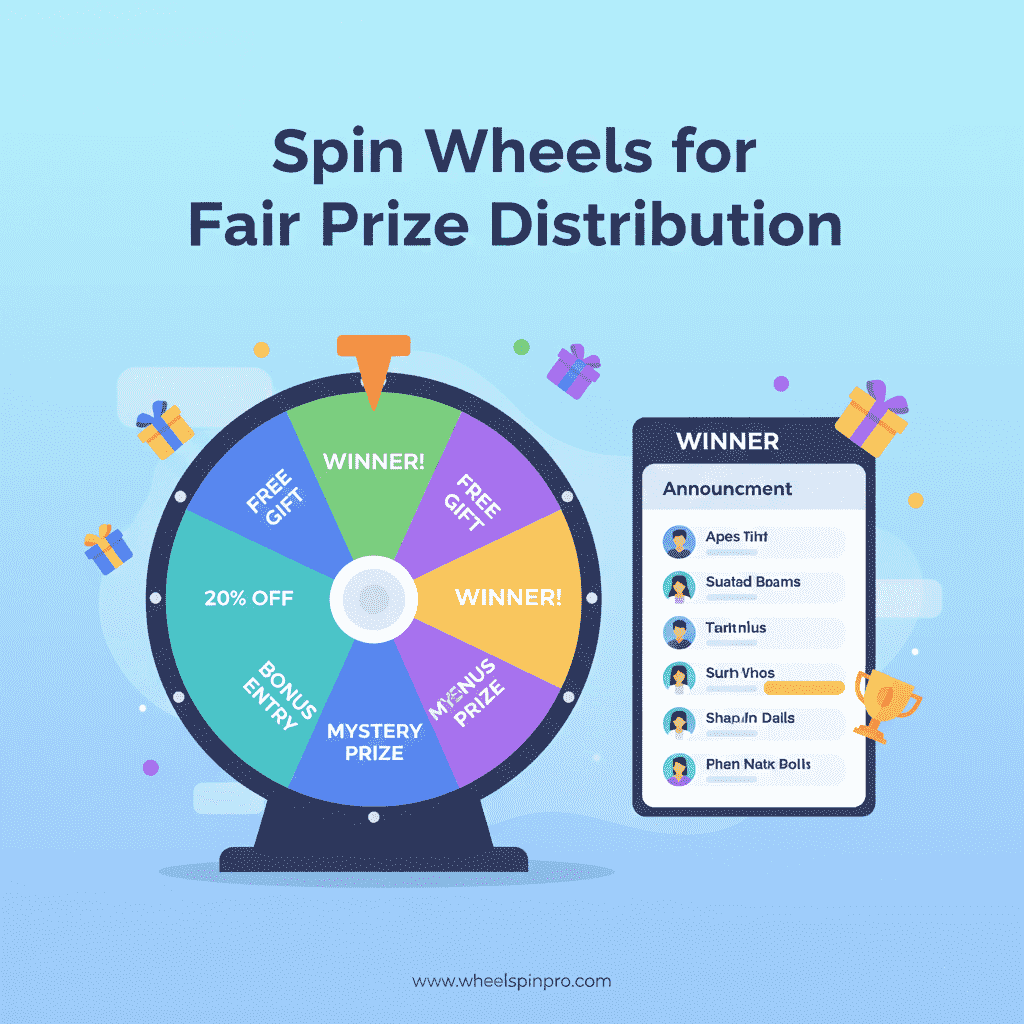
Spin Wheels for Fair Prize Distribution: How to Run Draws That Participants Actually Believe In
Announcing a winner isn't the same as proving the draw was fair. Most participants accept results they didn't receive only when they trust the process that produced them — and trust in a process requires seeing it, not just being told about it. Here's how to build that trust structurally, not aspirationally.
Prize distribution is a trust event. When an organizer announces a winner, every non-winning participant makes an instant, largely unconscious assessment: was this legitimate? The answer they arrive at — regardless of whether it reflects reality — determines whether the prize draw builds goodwill or destroys it.
The problem with most prize draws is not dishonesty. It is opacity. When a winner is announced without a visible selection process, participants have no basis for trusting the result beyond their pre-existing faith in the organizer. For participants who don't know the organizer well, or who are aware that the winner has a prior relationship with them, that faith is often insufficient.
The result is predictable: social media comments questioning the result, private speculation about favoritism, and a giveaway that was supposed to build relationships instead generating doubt. The organizer is left defending a process they can't demonstrate rather than celebrating a winner.
A spin wheel solves this problem at the source — by making the selection process visible, participatory, and non-human. This article covers why that visibility matters, how it interacts with the legal requirements for prize draws in many jurisdictions, and exactly how to run a spin wheel prize distribution that participants believe in — across every context from a live stream giveaway to a corporate event prize draw.
Why Perceived Fairness Matters as Much as Actual Fairness in Prize Distribution
Organizational psychology research on procedural justice — most foundationally established by Thibaut and Walker (1975) and extended by Tyler and Lind's relational model of authority — consistently demonstrates that the perceived fairness of a process affects participants' acceptance of outcomes at least as strongly as the outcomes themselves.
In plain terms: a participant who receives an unfavorable outcome from a visibly fair process accepts it at a higher rate than a participant who receives a favorable outcome from an opaque process. The process shapes the experience of the outcome, not just the outcome itself.
For prize distribution, this has a specific implication: a genuinely random selection conducted privately produces lower participant satisfaction and higher dispute rates than an equivalent selection conducted publicly — even when the underlying randomness is identical. The visibility of the process, not its technical integrity, is what participants respond to.
The Social Amplification of Doubt
In online and social media contexts, the cost of perceived unfairness is not linear — it is amplified by the visibility and reach of the people who express doubt. A single vocal participant questioning a draw result in a comment section can reach everyone who sees that post. A question about fairness that goes unanswered compounds into an implicit confirmation that the question was valid.
A visible spin wheel draw provides an immediate, demonstrable response to any such question: "Here is the video of the draw." That response closes the loop on doubt in a way that written assurances cannot.
The Legal Dimension: Why Verifiable Randomness Is Often a Requirement, Not Just Best Practice
Beyond trust and perception, prize distribution fairness carries legal weight in many jurisdictions. Promotional contests and prize draws are regulated activities in most markets, with specific requirements that affect how winners must be selected and documented.
Common legal requirements across major jurisdictions include:
- Equal probability of selection — all eligible entries must have an equal chance of being selected. A documented uniform random process satisfies this; a private manual selection may not be verifiable as satisfying it.
- Selection methodology documentation — organizers may be required to document the selection method and retain that documentation in case of audit or challenge. A recorded spin wheel draw constitutes this documentation; an undocumented manual selection typically does not.
- Separation of skill-based and chance-based promotions — pure luck draws (where winning depends entirely on random selection) must use a genuinely random mechanism. A spin wheel's PRNG-based selection satisfies this requirement; selection by a human who "randomly" picks satisfies it less clearly.
- Notarization or witness requirements — some jurisdictions or high-value promotions require that draws be conducted in the presence of a qualified witness. A live-streamed draw with hundreds of simultaneous witnesses provides stronger documentation than a private draw with a single designated witness.
What Makes a Prize Draw Verifiably Fair: The Three Requirements
Not all spin wheel draws are equally trustworthy. The trustworthiness of a draw depends on whether three specific conditions are met — all of which are achievable with a well-designed spin wheel deployment, and all of which are frequently missed in practice.
Condition 1: Verifiable Input
Participants must be able to confirm that they (and all eligible entrants) were included in the selection pool before the spin occurs. A draw from an invisible list produces claimed inclusion; a draw from a visible list produces confirmed inclusion.
Best practice: load entries onto the wheel on screen, before the community or audience, with enough time for members to scan the list and confirm their own entry. For large entry pools (hundreds or thousands of entries), display a count of total entries and allow members to search or confirm their entry before the draw begins. The verification step does not need to be exhaustive — what matters is that it was available, not that every participant used it.
Condition 2: Witnessed Process
The selection must occur in front of participants — live, on screen, in real time. Everyone watching sees the same unpredictable event unfold simultaneously. The result is not announced after a private decision; it is produced publicly in the moment of the spin.
This condition is what differentiates a transparent draw from a merely credible one. A credible draw asks for trust; a transparent draw earns it by performing fairness rather than claiming it.
Condition 3: Documented Record
The draw must be recorded and archived. A live-witnessed spin that leaves no record is trustworthy for those who were present and unavailable for verification by anyone who wasn't. A recorded draw extends the verification window indefinitely — participants who join after the announcement, skeptics who challenge the result weeks later, and regulators who request documentation all have access to the same verifiable record.
The recording is also the organizer's protection: if the result is ever challenged, a video of the draw is more defensible than any written claim.
Context-by-Context Implementation Guide
Online Contests (Social Media, Email, Website)
Online contests typically involve entries collected over days or weeks before a single draw event. The primary trust challenge is the gap between entry collection and draw — participants who entered early often can't remember whether they were included, and the draw feels disconnected from the participation that preceded it.
Give participants a specific time when the draw will occur and where they can watch it (live stream link, story, post). Advance notice converts passive entrants into active witnesses — dramatically increasing the audience for the draw and the social proof it generates.
Before adding individual names, show the total count of verified entries ("We have 847 eligible entries for today's draw"). This establishes the scale of the pool and signals that entry verification has already occurred — setting expectations before anyone can question whether their entry was counted.
For draws under 100 entries, load names directly on screen with the audience watching. For draws over 100 entries, use unique entry codes rather than full names (e.g., "Entry #0847") to maintain manageable wheel display while preserving verifiability — participants match their code to the winning entry rather than looking for their full name.
State explicitly that the entry pool is final and spin within seconds of the announcement. Any delay between announcing closure and spinning creates an opportunity for doubt about whether the pool was modified in the interval.
For social media draws: immediately post the spin clip (or a shortened version of it) as the winner announcement content. For website draws: embed the recording in the results post. For email contests: link to the recording in the winner announcement email. The video is the announcement; everything else is supporting information.
Live Stream Prize Draws (Twitch, YouTube, Instagram Live)
Live streaming provides the highest-trust environment for prize draws because the entire audience witnesses the selection in real time with no gap between the draw and the announcement. The live format converts potential skeptics into witnesses — and witnesses are natural defenders of the outcome they observed.
Live stream draw best practices:
- Build anticipation before opening the wheel — announce the draw coming up 5–10 minutes before opening the wheel; this draws viewers who are watching passively back to full attention and increases the live audience for the draw itself
- Add entries in real time if collecting during the stream — for draws where viewers enter during the live session (by commenting a specific word, subscribing, etc.), add entries to the wheel visibly as they come in; the live loading is itself engaging content
- Invite the chat to help watch — "Chat, watch to make sure your name is on the wheel" creates a verification community; hundreds of simultaneous viewers provide more robust input verification than any single person could
- React genuinely to the result — the streamer's authentic reaction to the winning name creates the emotional peak that makes the draw memorable and shareable; a flat announcement misses the engagement opportunity the draw format creates
Corporate Events and Employee Prize Draws
Corporate prize draws carry additional trust requirements because the relationship between organizer and participants is a professional one with power dynamics. An employee who believes a corporate prize draw was influenced by management favoritism has a different kind of grievance than a consumer who doubts a brand giveaway — it affects their relationship with the organization, their perception of management fairness, and their willingness to engage with future programs.
Corporate draw requirements:
- Ensure the draw is performed by or witnessed by a neutral party — HR representative, team lead uninvolved in the prize, or a facilitator — rather than by someone whose relationship to potential winners could be questioned
- Conduct the draw during a meeting where all eligible employees are present — all-hands calls, team meetings, or company events — so the entire eligible pool witnesses the process simultaneously
- Document eligibility criteria before the draw, not after — who was eligible to enter, based on what criteria, verified by whom. Post-draw eligibility disputes are among the most damaging trust incidents in corporate prize distribution
- Archive the draw recording in a location accessible to all participants — company intranet, shared drive, or HR documentation — creating a permanent verifiable record that any employee can access if questions arise later
Community Rewards and Regular Member Recognition
Community-based prize draws — for Discord servers, online communities, membership groups — occur within ongoing relationships where the trust implications of each draw compound over time. A single perceived unfair draw damages credibility that took months to build; a consistent pattern of transparent draws builds reputational capital that makes the community more resilient to future disputes.
For recurring community draws:
- Use a standing draw format that members recognize — same tool, same process, same position in the community event schedule — so the format becomes trusted through repetition, not just through explanation
- Post the draw recording in the channel where the draw was announced — creating a consistent archive location that members know to check and reference
- Rotate the types of prizes across draws — variety in what is being awarded maintains engagement; predictable prize types become routine and lose the draw's engagement value
- Use results history to ensure long-term fairness — track which members have won in recent draws and, where appropriate, temporarily reduce their eligibility probability; this distributes prizes across the community over time rather than concentrating them in a statistical cluster
Running Multi-Prize and Tiered Prize Draws With Spin Wheels
Many prize draws involve multiple prizes of different values — a first prize, second prize, and third prize, or a grand prize alongside runner-up rewards. The spin wheel approach for these draws requires slight modification to maintain both fairness and engagement.
Sequential Draw Method (Recommended)
Spin for the highest-value prize first. Remove the winner from the wheel before spinning for the next prize tier. Continue until all prizes are allocated. This method maintains the ascending anticipation arc — each subsequent spin draws from a progressively smaller pool — and ensures no participant wins multiple prizes (assuming that is the intent).
The engagement benefit: starting with the top prize captures maximum audience attention when viewing numbers are typically highest (at draw opening), then sustains engagement through subsequent tiers as remaining participants stay engaged until their own eligibility is exhausted.
Separate Pool Method (For Participation-Based Draws)
Some draws allow participants to win multiple tiers — for instance, a top-prize winner can also receive runner-up prizes. In this case, maintain a single pool throughout all spins and do not remove previous winners. Announce this rule clearly before the draw begins to prevent post-draw disputes from participants who expected the sequential method.
Weighted Prize Wheel Method (For Spin-to-Win)
For marketing spin-to-win formats where every participant receives a prize tier immediately upon spinning, weight the wheel segments by prize value: larger segments for lower-value prizes (free shipping, 5% discount), smaller segments for higher-value ones (significant discount, free product). Every spin wins something; the variable element is which tier — preserving the anticipation mechanism while ensuring the prize economics are sustainable.
Handling Draw Complications Transparently
Even well-prepared draws encounter complications. How an organizer handles complications is as important to trust-building as how they conduct a clean draw — because the manner of handling problems is itself a signal of integrity.
| Complication | Wrong Response | Right Response |
|---|---|---|
| Winner selected is ineligible (rule violation, excluded entry) | Quietly announce a different winner without explanation | Acknowledge publicly, explain the disqualification reason clearly, conduct a re-spin live from the remaining eligible pool, and archive both the original spin and the re-spin |
| Winner cannot be contacted or does not claim prize | Pick a replacement winner privately | Announce publicly that the original winner did not respond within the claim window, and conduct a live re-spin from the original eligible pool, recorded and posted |
| Technical error during the live spin | Claim the result anyway or pick manually | Acknowledge the technical issue transparently, reset the wheel to the same state, and re-spin — ideally in the same live session so the audience witnesses the correction |
| A participant claims they weren't included in the draw | Deny the claim without evidence | Reference the archived draw recording (where entries were visible), check against the verified entry list, and respond publicly with the evidence regardless of the outcome |
| Draw produces skepticism despite visible process | Defend the result and dismiss skeptics | Share the recording link, respond calmly to specific questions, and acknowledge that concern is understandable while providing the verifiable evidence that addresses it |
The consistent principle across all complications: transparency in adversity is more trust-building than a problem-free process, because it demonstrates that the fairness commitment extends beyond easy circumstances.
Using WheelSpinPro for Prize Distribution
WheelSpinPro provides the features that make the implementation steps above practical across all prize distribution contexts:
- Fast entry loading — add participant names or entry codes in seconds, with no formatting requirements; paste from a spreadsheet or type directly
- Results history tracking — automatically log every spin outcome as a built-in audit record; essential for multi-round draws and recurring community prize programs that require documentation of fairness over time
- Clean, high-contrast visual — renders clearly through screen shares on live streams, video calls, and screen recordings; no visual compression artifacts or interface clutter competing for audience attention during the draw moment
- Multiple formats for different contexts — Classic Wheel for standard prize draws, Lucky Box for grid-format prize reveal structures suited to multi-tier campaigns, Center Spin for large-screen display at in-person corporate events
- No account required to run a draw — zero technical friction during live draw moments; open, load, and spin without setup steps that interrupt the audience experience
- Works on all devices — desktop, tablet, and mobile compatible; no platform-specific requirements that create technical complications during live events
For the broader context of how spin wheels build trust in brand giveaway contexts beyond event prize draws, see our guide on fair giveaways and contests using online spin wheels.
Final Thoughts: A Prize Draw Is Worth Only as Much as Participants Believe It Is
The organizational value of a prize draw — the goodwill it builds, the engagement it generates, the loyalty it rewards — is entirely contingent on participants believing the draw was fair. A prize draw that produces doubt produces the opposite of its intended effect: it creates a record of a potentially unfair process that participants reference when evaluating the organizer's credibility in the future.
The solution is not more assurances of fairness. It is demonstrating fairness — visibly, verifiably, and consistently — through a process that participants can watch, check, and share.
A spin wheel, used correctly, is exactly this demonstration. It costs nothing beyond the five minutes required to load entries and spin. The trust it builds — and the doubt it preemptively eliminates — is worth disproportionately more than its operational simplicity would suggest.
Run your draws in public. Show the wheel. Record the spin. Archive the result. That is the entire practice — and it is the difference between a prize draw that participants accept and one they believe in.
📎 Related Articles on WheelSpinPro
- Fair Giveaways and Contests Using Online Spin Wheels — brand giveaway transparency, social media draws, and trust-building mechanics
- How Spin Wheels Improve Transparency in Online Communities — community-specific prize draw mechanics and conflict prevention
- Why Fair Decision-Making Matters — And How Randomization Fixes It — the psychology of procedural fairness and outcome acceptance
- Using Spin Wheels for Events and Team Building — live event prize draws and in-person engagement applications
- Try the Lucky Box — grid-format prize reveal tool ideal for multi-tier draw structures
Frequently Asked Questions
📚 External References
- Tyler, T. R. & Lind, E. A. (1992). A Relational Model of Authority in Groups — Advances in Experimental Social Psychology, 25. Research establishing that the perceived fairness of a process affects acceptance of outcomes as strongly as the outcomes themselves — foundational to understanding why procedural transparency matters in prize distribution. ScienceDirect
- Federal Trade Commission (FTC). Prize Promotions and Sweepstakes: Business Guidance. U.S. regulatory guidance on the legal requirements for promotional prize draws, including equal probability of selection and documentation standards. FTC.gov
- Colquitt, J. A. (2001). On the Dimensionality of Organizational Justice — Journal of Applied Psychology, 86(3). Research on how procedural fairness (the perceived fairness of the selection process) affects satisfaction and acceptance independently from outcome fairness — directly relevant to why visible draw processes produce higher acceptance rates than private selections. APA PsycNet

Written by the maker of Wheel Spin Pro
The developer behind Wheel Spin Pro's spin engines and 140+ unique pickers, writing practical guides on fair random selection for classrooms, giveaways, and events. More about the project.