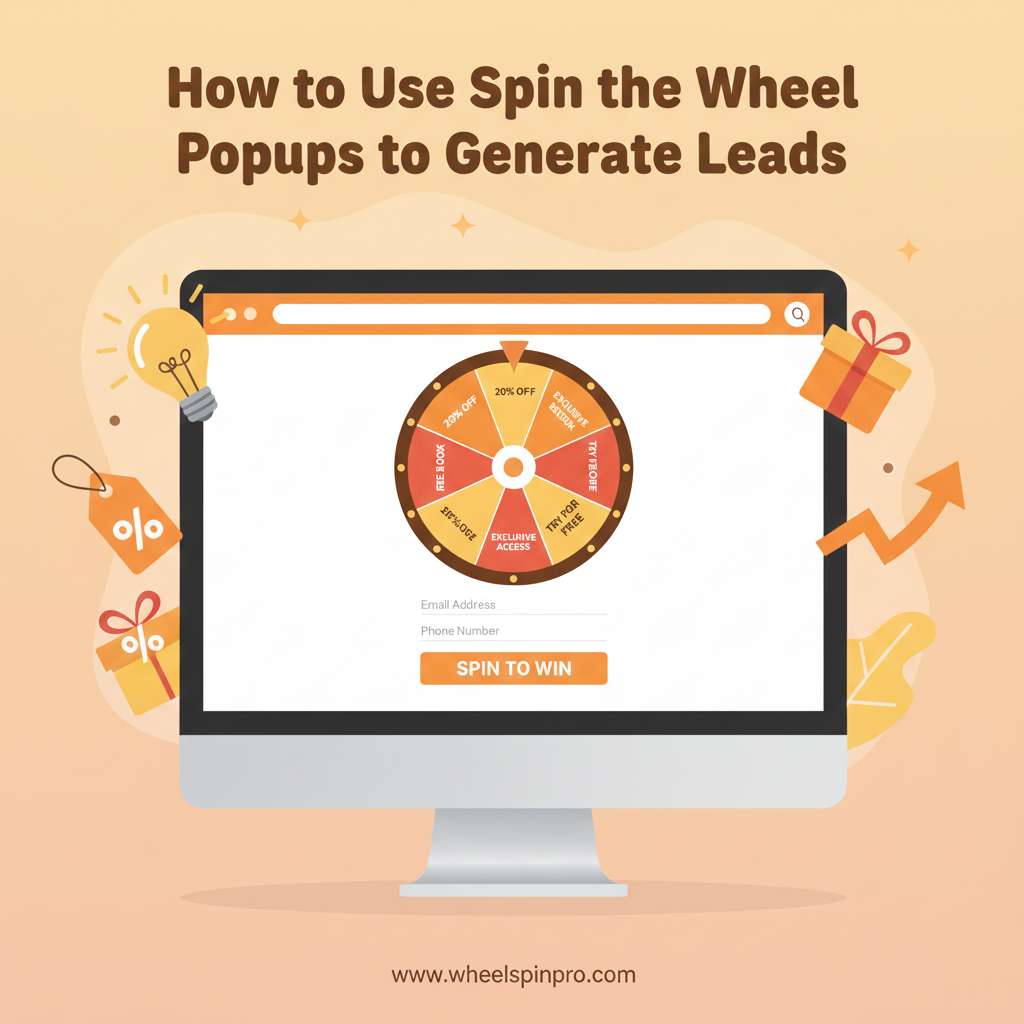
How to Use Spin the Wheel Popups for Lead Generation: A Complete Implementation Guide
Standard email popups convert 1–3% of visitors. Spin wheel popups, deployed correctly, convert 5–15%. The difference isn't the offer — it's the architecture of how the offer is experienced. This guide explains every element of that architecture, from reward design to follow-up sequence.
Lead generation sits at the intersection of two competing realities. On one side: every online business needs email subscribers, trial signups, and qualified contacts to survive. On the other: visitors have grown highly resistant to the forms, popups, and interstitials that have been used to capture those leads for the past two decades.
The resistance is not irrational. Standard lead capture forms feel like a transaction that benefits only the business — give us your personal information in exchange for a promotion you didn't ask for. The psychological framing is extractive, and visitors have learned to dismiss it reflexively.
Spin wheel popups reframe the transaction. Instead of asking for an email in exchange for a discount, they offer an interactive experience in which winning a reward requires an email. The sequence is identical; the psychological experience is fundamentally different — and the conversion data reflects that difference consistently.
But the conversion advantage of spin wheel popups is not automatic. It is produced by specific design decisions across seven implementation dimensions. Get those decisions right and you capture higher-quality leads at significantly better rates. Get them wrong and you add friction, reduce trust, and potentially perform worse than the standard form you replaced.
This guide covers every dimension of a high-performance spin wheel lead generation deployment.
Why Spin Wheel Popups Outperform Standard Forms: The Mechanism
Before building a spin wheel lead flow, it helps to understand precisely why the format works better — because that understanding shapes every design decision that follows.
The conversion advantage of spin wheel popups comes from four behavioral mechanisms that standard forms cannot replicate:
| Mechanism | What It Does | Why Standard Forms Lack It |
|---|---|---|
| Dopamine anticipation | Neurological engagement peaks during the uncertain spin phase — creating genuine investment in seeing the result | Standard forms have no anticipation arc — the reward is stated upfront, removing uncertainty |
| Earned reward framing | Rewards actively won feel more valuable than passively received equivalents (IKEA Effect) | Standard forms deliver rewards to passive recipients — the discount is given, not earned |
| Variable reinforcement | Uncertainty about which reward tier drives stronger engagement than predictable fixed offers | Standard forms offer a fixed, stated reward with no uncertainty element |
| Commitment consistency | Visitors who voluntarily initiate a spin have made an active commitment that creates forward purchase momentum | Standard forms create no active commitment — form-fillers are passive until the next touchpoint |
Understanding this table is what separates informed implementation from superficial deployment. Every design decision in the sections below is aimed at preserving and amplifying these four mechanisms — and the common mistakes are almost always decisions that inadvertently suppress one or more of them.
Step 1: Design a Reward Architecture That Maintains the Anticipation Effect
Reward design is where most spin wheel deployments are undermined before a single visitor sees them. The two most common mistakes — loss segments and reward tiers that feel unfair — both suppress the anticipation and earned-reward mechanisms that drive conversion.
The Core Principle: Every Spin Should Win Something
A wheel with "Better luck next time" segments is not a gamified reward — it is a lottery where most participants lose. This framing damages the perceived fairness that makes spin wheels more trusted than standard popups. Visitors who spin and receive nothing feel deceived rather than engaged, and the psychological response is worse than if you'd shown them a standard form.
Best practice: design every segment as a win. Use tiered rewards — some segments offer a larger prize, others a smaller one — but every segment delivers something of genuine value. This maintains the fairness perception while preserving the variable reinforcement mechanism (visitors still don't know which tier they'll receive).
Reward Tier Architecture: A Practical Framework
| Tier | Segment Share | Example Rewards | Purpose |
|---|---|---|---|
| Base tier | 50–60% of wheel | Free shipping, 5–10% discount, content download, free account feature | Ensures every visitor wins; baseline conversion driver |
| Mid tier | 30–35% of wheel | 15–20% discount, free trial extension, bonus product, early access | Creates aspiration and perceived value differential |
| Top tier | 5–15% of wheel | 25–40% discount, free product, significant service upgrade | Drives anticipation effect; seen as the "real prize" |
The top tier should be genuinely valuable — visible enough that winning it feels like a real event. But it should also be economically sustainable: if every visitor won your highest-value reward, the economics of the campaign would break. The tiered architecture balances aspiration with unit economics.
Reward Types by Business Model
Step 2: Design the Entry Gate for Minimum Friction
The entry gate is the moment between the visitor deciding they want to spin and them actually spinning — and every element of that moment must be optimized to minimize the friction that causes abandonment.
What to Ask For
Email address only. This is the universal best practice and the finding that has been replicated consistently across A/B tests in every industry. Adding a name field reduces completion rates by a statistically significant margin. Adding a phone number reduces completion rates dramatically. Adding any further fields compounds the effect.
The psychological contract of the spin wheel format is: "Give me your email, earn a spin." The moment the entry gate begins to feel like a full signup form, visitors reassess whether the reward is worth the information being requested — and a significant percentage conclude it is not.
Form Copy That Maintains the Game Framing
The language at the entry gate determines whether the visitor perceives the interaction as a game or as a form. These are meaningfully different psychological experiences:
| Element | Standard Form Framing | Game Framing (Higher Conversion) |
|---|---|---|
| Headline | "Sign up for 10% off" | "Spin to win your exclusive offer" |
| Subheadline | "Enter your email to receive discount" | "Enter your email for a chance to win up to 40% off" |
| Input placeholder | "Your email address" | "Your email to claim your prize" |
| Button CTA | "Subscribe" / "Sign Up" | "Spin the Wheel" / "Try My Luck" |
| Opt-out link | "No thanks" | "No thanks, I don't want a discount" |
The opt-out link copy deserves special attention. Phrasing the decline as "No thanks, I don't want a discount" (rather than a neutral "Close") forces visitors to consciously reject a stated value — a proven technique for reducing dismissal rates without being manipulative, since the visitor is simply being given an accurate description of what they're declining.
Consent and Compliance
Depending on your jurisdiction and marketing channel, you may need explicit consent for email marketing at the entry gate. GDPR (EU), CASL (Canada), and CAN-SPAM (US) all have specific requirements. Best practice across all jurisdictions: include a clearly visible, unchecked checkbox with a consent statement linked to your privacy policy. Make the checkbox mandatory before the spin is enabled. This adds a small friction element but protects you legally and produces a more qualified, consent-verified lead.
Step 3: Select the Right Trigger Strategy for Your Traffic Context
When your spin wheel popup appears is as important as what it offers. A poorly timed trigger suppresses the behavioral mechanisms that drive conversion; a well-timed trigger activates them at the moment of maximum receptivity.
The Four Trigger Types: Performance Compared
| Trigger Type | When It Fires | Typical Performance | Best Used For |
|---|---|---|---|
| Exit intent | Cursor moves toward browser close / URL bar | Highest (visitor is departing; last chance) | E-commerce product and cart pages; any high-bounce page |
| Time delay | 20–45 seconds after page load | High (visitor has formed intent; engagement is established) | Landing pages; content pages with longer read time |
| Scroll depth | Visitor scrolls past 50–70% of page | High for content sites (demonstrates genuine engagement) | Blog posts; long-form product pages; educational content |
| Immediate page load | 0–3 seconds after arrival | Lowest (interrupts before intent forms) | Avoid for standard deployments; use only on dedicated promotional landing pages where spin is the primary content |
Trigger Stacking: The Multi-Trigger Approach
Advanced deployments use trigger stacking — where the popup fires on whichever condition is met first. A common high-performance configuration: time delay of 30 seconds OR exit intent, whichever occurs first. This ensures visitors who engage briefly and depart quickly are captured on exit, while visitors who read deeply see the wheel after they've demonstrated genuine interest.
Frequency Capping: The Most Overlooked Setting
A spin wheel that appears on every page visit or every session is not an engagement tool — it is an annoyance. Set a strict frequency cap: once per visitor per session, and once per visitor per 30 days maximum. Some platforms allow you to suppress the wheel for visitors who have already converted — which is essential to avoid alienating new subscribers with repeat exposures.
Frequency capping does reduce the raw number of wheel displays. It also reduces dismissal rates, maintains positive brand perception, and produces a cleaner lead list — more than compensating for the reduced display volume.
Step 4: Optimize the Spin Experience for Maximum Anticipation
The spin itself — the visual and audio experience between clicking "Spin" and the wheel stopping — is the peak engagement moment of the entire interaction. Its design directly affects perceived reward value, emotional response to the outcome, and the forward momentum toward redemption.
Spin Duration
The optimal spin duration is 3–6 seconds. Shorter than 3 seconds and the anticipation arc is truncated — the dopamine response doesn't have time to build. Longer than 8 seconds and the experience tips from exciting into frustrating, increasing abandonment before the result is revealed.
Visual Design and Brand Consistency
A spin wheel that looks visually inconsistent with your site signals low quality — the same signal a poorly designed landing page sends about the product behind it. The wheel should use your brand's primary color palette, match your site's typography weight and style, and feel like a natural extension of the page rather than an embedded third-party widget.
This matters more than most marketers realize. A visually dissonant wheel doesn't just look bad — it undermines the trust and credibility that are the psychological prerequisites for the lead capture to work. A visitor who has already formed a positive brand impression will convert; a visitor who sees something that looks off-brand begins to question the quality of everything on the page.
Sound Design
Subtle audio feedback during the spin and at the result moment increases engagement measurably — the auditory cue adds a sensory dimension to the anticipation arc. However: always offer a mute option. Unexpected sound on a website is one of the fastest ways to produce an immediate, hostile dismissal response — particularly for visitors browsing in public or work contexts.
Step 5: Deliver the Reward Instantly and Frictionlessly
The gap between winning a reward and being able to use it is where a substantial portion of spin-to-win conversions are lost. The psychological momentum created by the spin — the dopamine peak, the earned-reward feeling, the forward commitment — is time-sensitive. Every additional step between reward receipt and redemption opportunity allows that momentum to decay.
On-Screen Delivery
Display the reward code or reward details on the same screen, immediately after the spin stops. Do not redirect to a separate page. Do not require account creation before the code is shown. The reward display should be the next visual the visitor sees after the wheel stops — no intermediate steps, no loading screens, no confirmation gates.
Email Confirmation Timing
Send the reward confirmation email within 60 seconds of the spin. Not within the hour — within 60 seconds. The email serves two purposes: it delivers a persistent copy of the reward that the visitor can return to later, and it demonstrates that the email address they provided is already being used to benefit them, which reduces the unsubscribe impulse in subsequent emails.
The confirmation email should contain: the specific reward they won (not generic promotional language), a single-click redemption link or prominent code display, a clear expiry date, and a minimal link to your main product or service. This is not the email to begin a full marketing sequence — that comes after.
Expiry Period Design
The expiry period on the reward affects conversion in ways that are counterintuitive. Too short (under 12 hours) feels punishing and creates anxiety rather than urgency — visitors who can't redeem immediately feel cheated, producing negative brand association. Too long (over 14 days) removes urgency entirely and allows the reward to expire unconsidered.
The optimal expiry window depends on your purchase cycle length. For impulse purchases: 24–48 hours. For considered purchases (apparel, electronics): 5–7 days. For high-consideration purchases (SaaS, B2B): 14 days. Frame the expiry as a deadline, not a threat — "Claim your reward before [date]" rather than "Expires in 24 hours."
Step 6: Build a Follow-Up Email Sequence That Converts Reward-Winners Into Customers
The spin interaction captures the lead. The follow-up email sequence converts the lead. These are two separate jobs — and conflating them (by making the confirmation email also a promotional pitch) damages both.
The Four-Email Spin Winner Sequence
Reward code prominently displayed. Single-click redemption link. Brief reminder of what they won and how to use it. Nothing else — no upsells, no product recommendations, no newsletter content. The only job of this email is to deliver what was promised, instantly and clearly.
Remind them of their unused reward with a clear expiry deadline. Add 2–3 customer reviews or social proof elements that validate the product quality alongside the reward reminder. This combines urgency with trust — the two primary drivers of purchase action in a single email.
For subscribers who have not yet redeemed: introduce your best-selling products or most popular service tier in the context of their reward. Frame this as "here's where most people use your discount" — practical guidance that also functions as a curated product introduction.
Final reminder if the reward is expiring. For rewards already used: transition the subscriber to your standard welcome or nurture sequence. For non-converters: remove the reward urgency framing and begin a standard brand introduction sequence — the spin-specific context has run its course.
Step 7: Prevent Abuse Without Adding Friction for Legitimate Visitors
Any lead generation mechanism that delivers real value will attract attempts to game it — users who submit multiple email addresses to spin multiple times. Left unaddressed, this inflates your lead count with low-quality contacts and depletes your reward budget on non-qualified participants.
The challenge is implementing abuse prevention without creating enough friction to suppress legitimate completions. These are the most effective low-friction abuse prevention measures:
- IP-based frequency limiting — restrict the number of spins from a single IP address per time period. This catches most repeat submissions without affecting legitimate visitors. Note: this is imperfect for shared IPs (offices, universities) — set thresholds that account for this.
- Email domain validation — real-time validation that the submitted email address uses a valid domain format and is not on a known disposable email provider list. Disposable email addresses are the primary vehicle for spin abuse.
- Delayed reward delivery — sending reward codes via email rather than displaying them on-screen forces use of a real email address. A visitor who provides a fake email to see the on-screen code can spin multiple times without consequence; if the code is email-only, every spin requires a deliverable address.
- Single-use codes — generate unique discount codes rather than a universal code that can be shared. Unique codes are trackable, non-transferable, and usable only once — which both prevents sharing and provides redemption analytics.
How to Measure Whether Your Spin Wheel Popup Is Actually Working
Raw email capture rate is not the right primary metric for spin wheel lead generation performance. It measures one part of the funnel while ignoring whether that funnel is producing value. These are the metrics that matter — and how to interpret them:
| Metric | What It Measures | Healthy Benchmark | What Low Performance Indicates |
|---|---|---|---|
| Spin rate | % of wheel-viewers who initiate a spin | 30–50% | Poor trigger timing or weak visual design |
| Completion rate | % of spinners who submit email | 75–85% | Entry gate friction — too many fields or poor copy |
| Reward redemption rate | % of winners who use reward within expiry | 25–45% | Reward-audience mismatch or poor redemption UX |
| Revenue per spin-lead | Average order value × purchase rate for spin captures | Compare vs. standard form leads | Reward miscalibration or poor follow-up sequence |
| Email engagement rate | Open and click rates for spin-captured list vs. standard | Spin leads should outperform standard by 15–30% | Low differentiation suggests poor commitment effect |
| Unsubscribe rate | % who unsubscribe within 30 days | Below 2% for quality spin captures | Reward-audience mismatch or sequence too aggressive |
The most important composite metric is revenue per visitor on spin-active pages — which captures the full funnel impact of the spin wheel rather than a single stage. If this metric improves after deployment and holds through A/B testing, your spin wheel is working. If it doesn't improve despite good individual stage metrics, the sequence between capture and conversion has a problem that optimizing the spin alone won't fix.
Using WheelSpinPro for Spin Wheel Lead Generation
WheelSpinPro provides the features that make the implementation steps above practical rather than aspirational:
- Customizable segment structure — set reward tiers, control segment size and probability weighting, and ensure every segment delivers value
- Brand-consistent visual customization — match colors, typography, and wheel style to your site identity
- Results history tracking — log outcomes across sessions for multi-draw campaigns and redemption tracking
- Multiple spinner formats — Classic Wheel for standard spin-to-win, Lucky Box for grid-format reward reveals suited to multi-tier campaigns
- Device compatibility — full touch optimization for mobile, tablet, and desktop without performance loss
- No install required — browser-based, low technical barrier for deployment across any site platform
For the broader context of how spin wheel games drive website engagement beyond lead capture, see our guide on why spin-to-win games increase website engagement.
Final Thoughts: Lead Generation Is a System, Not a Widget
A spin wheel popup is a single element in a lead generation system. It can be the highest-converting element in that system — but only if the reward architecture, entry gate, trigger timing, spin experience, reward delivery, follow-up sequence, and measurement framework are all designed with the underlying behavioral mechanics in mind.
Deployed as a standalone widget without that context, it will perform better than a standard popup — the behavioral advantage is real and measurable. But deployed as part of a deliberately designed system, it can transform the economics of a website's lead generation entirely.
The seven steps in this guide cover the full system. Each one affects a specific metric and a specific behavioral mechanism. Work through them in order, measure each stage, and optimize based on data rather than assumption — and you'll find that the conversion advantage documented in spin wheel case studies is not an accident. It is an architecture.
📎 Related Articles on WheelSpinPro
- What Is a Spin the Wheel Game? How It Works & Why It Converts — full technical and psychological breakdown of spin wheel mechanics
- Why Spin-to-Win Games Increase Website Engagement — the behavioral science behind engagement metrics and deployment
- Fair Giveaways and Contests Using Online Spin Wheels — prize draws, transparency, and brand trust mechanics
- Try the Classic Spin Wheel — build your lead capture wheel in under a minute
- WheelSpinPro Features — full overview of customization, formats, and deployment tools
Frequently Asked Questions
📚 External References
- Cialdini, R. B. (2006). Influence: The Psychology of Persuasion — Harper Business. Foundational research on commitment, consistency, and the behavioral effects of voluntary action on subsequent behavior — the mechanism behind spin-initiated purchase momentum. HarperCollins
- European Data Protection Board. Guidelines on Consent under Regulation 2016/679 — GDPR consent requirements for email marketing and lead capture, including the freely given, specific, informed, and unambiguous consent standard. European Data Protection Board
- Norton, M. I., Mochon, D., & Ariely, D. (2012). The IKEA Effect: When Labor Leads to Love — Journal of Consumer Psychology, 22(3). Research on how active participation in an outcome increases the perceived value of the result — the mechanism behind spin-won versus passively-received reward valuation. ScienceDirect

Written by the maker of Wheel Spin Pro
The developer behind Wheel Spin Pro's spin engines and 140+ unique pickers, writing practical guides on fair random selection for classrooms, giveaways, and events. More about the project.